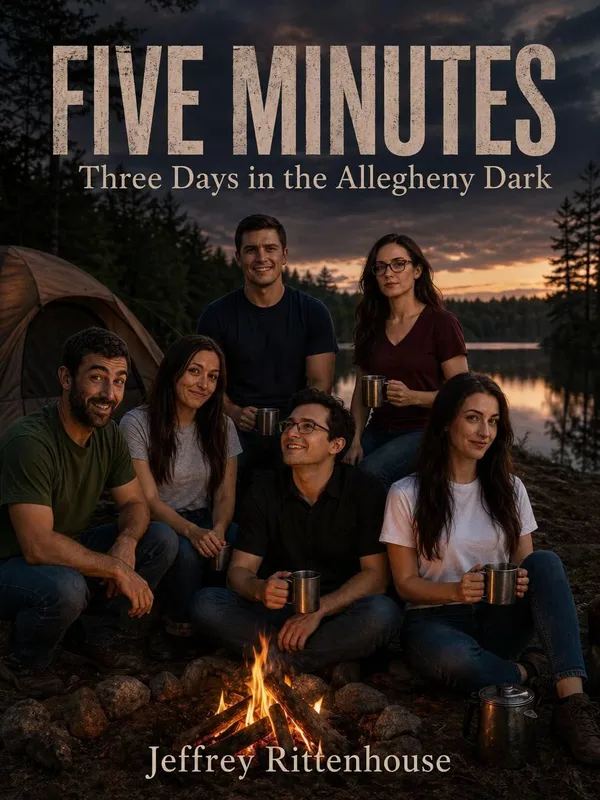
Free to read: the first chapter
Five Minutes
Chapter One
The morning they left Kulpsville, Sam Smucker had a laminated checklist.
Nobody had asked him to make a laminated checklist. Nobody had suggested it, encouraged it, or implied in any way that a laminated checklist was necessary for a camping trip to Allegheny National Forest. Sam had made it anyway, on the school’s laminator during a free period on Thursday afternoon, because Sam Smucker was a high school math teacher and the kind of person who believed that preparation was a form of love.
The checklist had 47 items.
“You laminated it,” Sarah Lapp said when she saw it.
She was standing in the parking lot of Towamencin Mennonite Church at seven in the morning, holding two paper grocery bags and squinting at the checklist, as it had personally offended her. The June sun was already warm on the asphalt, the sky a clean, uncomplicated blue, and Sarah was wearing a t-shirt that said WORLD’S OKAYEST CAMPER, which she had ordered online specifically for this trip.
“It’s waterproof this way,” Sam said.
“We’re going camping, Sam. Not to Neptune.”
“Rain happens on camping trips.”
“It’s June. It’s not going to rain.”
“You can’t know that with certainty.”
Sarah stared at him. Then at the checklist. Then back at him. “How many items?” she asked.
“Forty-seven,” Sam said. “But some of them are subcategories, so technically...”
“I’m getting in Noah’s car,” Sarah said, picked up her grocery bags, and walked away.
Sam watched her go. Then he looked back at his checklist and made a small, precise checkmark next to item number three: Confirm all parties present and accounted for.
* * *
Across the parking lot, Brian Yoder was loading the last of the gear into the back of his truck and trying very hard not to look at Debbie Stoltzfus, who was standing ten feet away helping Noah Brenneman wrestle a tent bag into shape and laughing at something Noah had said. Brian had been trying very hard not to look at Debbie for approximately two years, and he was, by any objective measure, terrible at it.
“You’re doing it again,” said a voice beside him.
Brian turned. Ruth Detweiler was standing there with a small, neat duffel bag and an expression that conveyed a great deal while committing to nothing.
“Doing what?” Brian said.
Ruth glanced across the parking lot toward Debbie. Then back at Brian. She said nothing. She didn’t have to.
“I’m loading the truck,” Brian said.
“You’ve been loading that same bag for four minutes,” Ruth said.
Brian picked up the bag, which was in fact already loaded, and put it back in the truck again. “There,” he said. “Still loading.”
The ghost of a smile crossed Ruth’s face. She picked up her duffel and walked toward Noah’s car. Brian looked after her, then back across the parking lot at Debbie, who had finished with the tent bag and was now walking toward him with her backpack slung over one shoulder and her hair loose in the June morning and a smile that had absolutely no idea what it did to people.
“You ready?” she said.
“Been ready,” Brian said.
“Sam made a laminated checklist.”
“I know. I’ve seen it.”
“It has forty-seven items.”
“I heard it might be subcategories.”
Debbie laughed, a real laugh, the kind that reached her eyes, and Brian thought, not for the first time and not for the last, that he should probably say something. Something honest and direct and overdue. He had been thinking it for two years. He was very good at thinking it.
“Let’s go,” he said instead, and opened the passenger door for her.
* * *
The drive from Kulpsville to Allegheny National Forest was four hours and change on a good day, and on a Friday morning in June with the windows down and the radio on, it felt like the best four hours Brian Yoder had spent in recent memory.
There were two cars. Noah’s SUV carried Noah, Ruth, and Sarah, who had claimed the entire back seat with the cheerful authority of someone who had done the math on personal space and found it satisfactory. Brian’s truck carried Brian, Debbie, and Sam, who had spent the first twenty minutes of the drive consulting his laminated checklist and the next twenty minutes explaining to no one in particular why the checklist was actually quite reasonable if you thought about it properly.
“Nobody’s thinking about it,” Debbie said pleasantly from the passenger seat.
“The waterproofing alone...”
“Sam.”
“Right,” Sam said, and folded the checklist and put it in his shirt pocket, where it made a small crackling sound every time he moved.
They took Route 422 west out of Kulpsville, through the wide, flat farmland of Montgomery County, and then north by degrees as Pennsylvania slowly changed around them. The suburbs thinned, the hills rose, the trees thickened along the roadside until the road itself felt like something threading through the forest rather than something laid across it. The morning stayed perfect. The kind of June morning that made you feel briefly, almost embarrassingly grateful to be alive.
Brian drove with one hand on the wheel and the window down and the warm air moving through the truck, and he felt something he’d been trying to locate for a long time. Something close to peace, or the outline of it, the shape of the place where peace might live if he could get there.
He’d been the one who suggested the camping trip. Six months ago, on a Sunday afternoon after service, when the six of them were standing in the parking lot, the conversation had reached one of those natural endings that could either become goodbye or become something else. He’d said it almost without thinking: We should go camping. Allegheny. This summer. And everyone had agreed so immediately, so easily, that it felt less like a decision and more like something that had already been true and just needed saying.
He hadn’t examined his reasons too closely since then. He was better at not examining things.
“Brian,” Debbie said.
“Yeah.”
“You just missed the exit.”
Brian looked at the GPS. Then, at the road behind them. “I did,” he said.
“Where were you?”
“Just thinking.”
Debbie looked at him for a moment with the particular expression she had. The one that suggested she was seeing something you hadn’t said out loud. She’d always had that expression. It was one of the seventeen things about Debbie Stoltzfus that Brian kept in a list he never intended to make.
“It’s fine,” she said. “There’s another exit in four miles.”
“Thank you.”
“Also you passed a gas station and we’re at a quarter tank.”
“I see it.”
“I’m just saying...”
“Debbie.”
“Yes?”
“I know.”
She smiled and turned back to the window. In the back seat Sam made the checklist crackle.
* * *
In Noah’s car, things were quieter.
This was always the way of it. Noah Brenneman had a gift for silence. Not the uncomfortable kind, not the loaded kind, but the solid, restful kind that felt like good timber. You could lean on Noah’s silence and it held. Ruth Detweiler, who had known him for the better part of a decade, had always appreciated this about him, though she had never said so directly because Ruth Detweiler did not say things like that directly.
She was reading. A slim paperback she’d been working through for two weeks, which was slower than her usual pace but which she was in no hurry to finish. From the back seat, Sarah’s voice arrived in regular intervals like a radio station briefly in range.
“Okay, but here is my question,” Sarah said. She was lying across the entire back seat with her feet against one window and her head against the other, and both grocery bags of trail mix were balanced on her stomach. “Why does camping require so much stuff? Every time I go camping, I bring more stuff than I normally do.”
“You’ve been camping twice,” Ruth said, without looking up from her book.
“And both times I brought too much stuff. That’s a pattern, Ruth. That’s data.”
Noah said nothing. He drove with both hands on the wheel, steady and unhurried, the way Noah did most things.
“I have eleven kinds of trail mix,” Sarah continued. “Eleven. I counted. Does anyone here believe that I need eleven kinds of trail mix?”
“No,” Ruth said.
“Correct. I don’t. And yet here they are. All eleven of them.”
“Why did you make eleven kinds?” Noah asked.
“Because I only planned to make eight,” Sarah said, “but then I thought, what if someone doesn’t like coconut? And then I thought, what if someone doesn’t like raisins? And then things kind of spiraled.”
“You could have just asked us if we liked coconut,” Ruth said.
Sarah considered this. “That’s a very reasonable point,” she said. “I resent it.”
Noah’s mouth moved in what, for Noah Brenneman, constituted a broad grin.
They drove north through the brightening morning, and Sarah talked, and Ruth read, and Noah drove, and somewhere in the easy rhythm of it, Ruth closed her book on her thumb and looked at the Pennsylvania landscape unrolling past her window. The old farmhouses, the white fences, the hills getting bigger and wilder and more wooded. She felt something she didn’t entirely trust. Something that felt like the possibility of a good few days.
She looked at the back of Noah’s hands on the wheel.
She opened her book again.
* * *
“Okay,” Sam said, approximately two and a half hours into the drive. He had retrieved the laminated checklist from his shirt pocket. “Rest stop coming up in six miles. I think we should...”
“Sam,” Brian said.
“I’m just saying that hydration is...”
“We’re fine.”
“Statistically, people underestimate how much water...”
“Sam,” Debbie said. Her voice was warm but final. The voice of a pediatric nurse who had explained things to small children for eight years and had become genuinely gifted at it.
Sam looked at Debbie. Then at Brian. Then at the checklist. He folded it back into his shirt pocket. “The rest stop has good coffee, is all I’m saying,” he said quietly.
They stopped for coffee.
It was, as Sam had predicted, good coffee. They stood in the gas station parking lot for ten minutes in the June sunshine, Brian leaning against the hood of his truck and Debbie sitting on the tailgate and Sam checking items off his list with the quiet satisfaction of a man whose systems are functioning as intended.
“Can I ask you something?” Debbie said to Brian.
“Sure.”
She was looking at her coffee cup, turning it slowly in her hands. “Why Allegheny? You could’ve picked a dozen places closer. Ricketts Glen. French Creek. Why’d you push for Allegheny specifically?”
Brian thought about this. He looked out at the parking lot, at the flat Pennsylvania sky beginning to show the first suggestions of heat shimmer.
“I needed somewhere big,” he said finally.
“Big,” Debbie said.
“Big enough that you can’t see the edges of it. Big enough that it feels...” He stopped. “I don’t know. Real.”
Debbie was quiet for a moment. In the way she had of not filling silences just because they were there. Brian looked at his coffee.
“I think I know what you mean,” she said.
He looked at her then. She was watching him with those steady, perceptive eyes, and for just a moment, everything that had been carefully kept at a reasonable distance between them was close enough to touch.
Sam’s checklist crackled.
“All right,” Sam said, capping his pen with a crisp click. “We are currently four minutes behind schedule. I think if we make good time on the next stretch, we can recover most of that. Brian, you’ll want to take the left fork at...”
“Sam,” Brian and Debbie said simultaneously.
Sam looked between them. “Right,” he said. He got in the truck.
* * *
The forest announced itself gradually, the way all great things do.
The trees along the roadside had been thickening for the last hour, but somewhere north of Clarion, something shifted. The light changed quality, filtered green and cool through the canopy, and the road narrowed, and the shoulders disappeared, and the forest pressed close on both sides like it had been waiting for them specifically.
In Brian’s truck, even Sam went quiet.
There was just the road and the trees and the occasional flash of the Allegheny Reservoir through the gaps in the forest. Dark water catches the early-afternoon sun in brief, brilliant flashes. Brian caught his first glimpse of it and felt something move in him. Something old and quiet and unnameable, like a compass needle deciding which way was north.
He’d been drifting for two years. He knew it. He’d been sitting in his pew every Sunday at Towamencin, standing for the hymns, bowing his head at the right moments, and somewhere along the way the thing that was supposed to be underneath all of it had gone quiet on him. Not dramatically. Not with any crisis he could point to. Just a slow, private dimming, like a light on a thermostat being turned down so gradually you don’t notice until the room is different.
He hadn’t told anyone. There wasn’t a category for it in his world. Not a clean one. You believed, or you were working through doubting, or you had left. Brian hadn’t left. He didn’t want to leave. He just couldn’t find the thing he was supposed to be holding onto.
He looked at the forest moving past his windows.
Big enough that it feels real.
He hadn’t known he was going to say that until he said it. He hadn’t known it was what he was looking for until Debbie asked.
“Look at that,” Debbie said softly.
Through a wide gap in the trees, the Allegheny Reservoir spread out beneath the afternoon sky. Massive and dark and still, stretching so far that the far shore was a thin line of green on the horizon. It was the most beautiful thing Brian had seen in a long time. Maybe because beauty had been feeling far away from him. Maybe because something about this specific water, this specific forest, this specific afternoon, felt like an answer to a question he hadn’t quite finished asking.
“Yeah,” Brian said.
In the back seat, Sam had his face turned to the window like a kid on his first road trip. He didn’t say anything about the checklist. He didn’t say anything at all.
* * *
They found Dewdrop Campground at two-fifteen in the afternoon, down a gravel road off Route 666 that wound through the forest for a mile and a half before opening into a clearing so perfectly situated that Sarah, who was pulling in behind them in Noah’s car, said “oh” in a tone of voice that nobody from their congregation would have recognized.
The campsite was flat and wide, ringed by old-growth hemlock and white pine, the trees enormous and straight and full of a green so deep it was almost blue. A fire ring sat at the center, blackened and solid. Picnic tables. A wooden post with the site number. And at the edge of the clearing, through a screen of hemlock boughs, the Allegheny Reservoir.
The water was forty feet away. Still and dark and vast, stretching out to the north until the forest swallowed it. A wooden dock, old but sturdy, reached out over it. The afternoon light lay on the surface in long, gold strips.
They stood at the water’s edge for a moment, all six of them, without any of the usual talking, and looked at it.
“Okay,” Sarah said finally. “I take back every complaint I have ever made about this trip.”
“You haven’t made any complaints,” Sam said.
“I’ve been saving them,” Sarah said. “And now I’m releasing them. Into the lake. They’re gone.”
“That’s not environmentally...”
“Sam.”
“Right.”
Brian stood a little apart from the others, looking out across the water. The reservoir was perfectly silent. The forest behind them was perfectly silent. The only sound was the small movement of the water against the dock, a soft, rhythmic sound, almost like breathing.
He thought: I needed somewhere big enough to feel real.
This was real.
Noah appeared beside him, quiet as always, and looked at the water with him for a moment.
“Good call,” Noah said. Just that. Two words.
Brian nodded. It was enough.
Behind them, Sam had retrieved his checklist and was counting tent poles. Sarah was explaining to Debbie the precise philosophy behind each of the eleven trail mixes. Ruth was already scanning the campsite with the methodical efficiency she brought to everything, locating the path to the restrooms, noting the fire ring, calculating distances.
Brian looked at the Allegheny Reservoir one more time.
Somewhere out in the middle of it, a fish broke the surface and disappeared.
The water went still again.
Brian Yoder smiled, a real one, the kind that reached somewhere deeper than his face, and went to help with the tents.