Free to read: the first chapter
Where the Hands Meet
One
Nora. Lugano, the night of Sant'Antonio.
The watch had stopped at five past nine, and in three days, Nora had not been able to make it start.
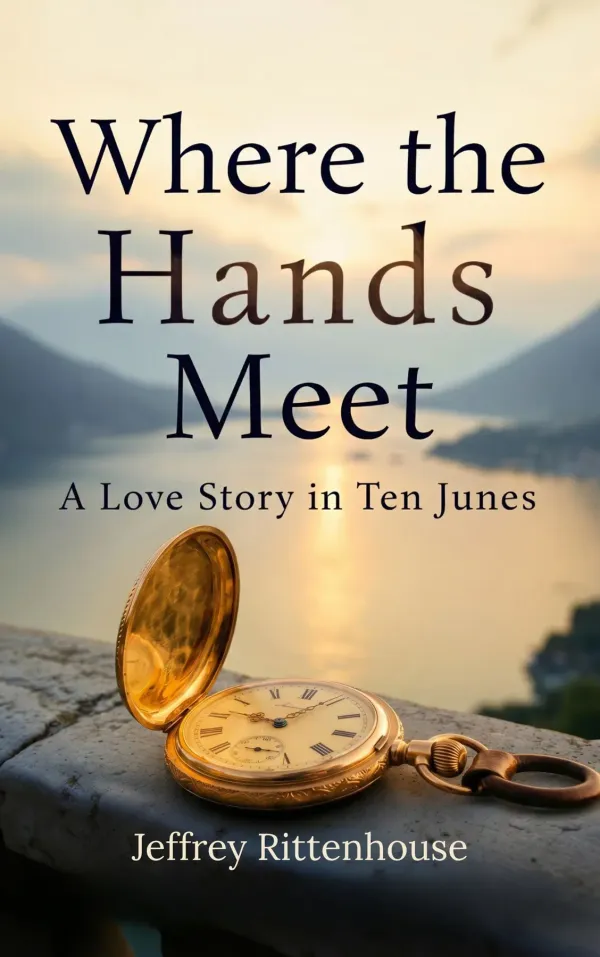
She carried it through the old town in its felt bag, held against her hip the way you carry something asleep. A 1911 Patek, hunter case, the sort of object that usually told her everything about itself the moment she opened it. This one had told her nothing. The mainspring was sound. The balance was clean. That afternoon she had laid its parts across a borrowed table at the villa, under a borrowed lamp, and found not one reason for it to be dead. Then she had put it back together and it had stayed dead. Five past nine. The little second hand frozen mid-step, like a held breath.
Her father would have had it running by lunch. That was the thought she kept stepping on all week, the way you step on the same loose stair in the dark.
Out in the lanes the town had gone soft and loud. It was the feast of Sant'Antonio, the man at the villa had told her, warning her the way you would warn a guest about roadworks, and now she understood the warning. The whole of Lugano had come down to the water. Paper lights swung between the shutters. Long tables ran down the middle of the streets, the smell of fish skins blackening on grills moved through everything, and in the doorways and on the steps of the churches there were couples, couples, couples. It was a town for couples tonight. She had planned for a quiet errand and an early train. She had not planned for this.
A girl of eight or nine stepped into her path and lifted a basket, and before Nora could find the Italian for no, thank you, there was a slip of paper in her hand. Thin stuff, blue ink, a printed line along the top and a blank space beneath. All around her people were bent over the same slips with pencil stubs, folding them, carrying them down toward the lake. She turned hers to the light. She could read enough Italian to order coffee and to apologize. This was neither.
"It's a wish," a voice said, in English, close to her shoulder. "You write one in the space and float it on the water. The printed line is the beginning. You're meant to finish it."
She did not turn right away. She had spent a week being helped by strangers, the man at the villa, the woman at the hotel, the conductor who had walked her down the platform as though grief were a kind of limp, and she had grown tired of the particular softness people kept using on her.
"And then it sinks," she said.
"And then it sinks." He came around into her eyeline. American. A few years older than her, thirty perhaps, though he wore it like more. Several days unshaven. A grey camera bag with the strap worn pale, and no camera anywhere on him. He was looking at the slip and not at her, which she found she did not mind. "Saint Anthony. He's the one you ask for lost things. People give him a bad week, and he turns up the keys, the dog, the husband. Tonight, you tell the lake what you have lost, and the saint does the rest." He lifted a shoulder. "Or you get a wet piece of paper. I have seen it go both ways."
"What does it say?" she said. "The printed part. I can't read it."
He took the slip from her hand without asking, as some people do, and read it without effort. "Se il tempo vuole." He gave it back. "If time is willing."
If time is willing. She almost laughed, and the almost surprised her. She had a dead watch against her hip that cared nothing for what time was willing, and a father three weeks in the ground who had run clean out of it, and here was a stranger handing her a wish that opened on a clockmaker's joke.
"You're not writing one," she said.
"I don't lose things." He said it lightly, and it landed wrong, the way a light thing can, and for a moment neither of them did anything with it. Then he nodded at the felt bag. "You're holding that like it might wake up."
"It's a watch."
"It's nine at night, and you're carrying a watch through a street party like a relic."
"It's a 1911 Patek, and it's worth more than this street," she said, "and it's stopped, and I can't start it, and I am supposed to be very good at starting them." The last part came out before she could stop it, flat and true, in her father's cadence, and she closed her mouth on the rest.
He looked at her then. Properly, for the first time. Not the soft look. Something nearer the way she looked at a movement under the loupe, trying to see what was actually wrong instead of what ought to be.
"Show me," he said.
"You mend watches."
"No. I have spent my whole life pointing a lens at things that won't tell me what happened to them." Almost a smile. "I find it helps to look anyway."
They ended at the low wall where the piazza ran out, and the lake began, because she was not going to open a Patek on a café table slick with wine. She took the loupe from her coat, because she always had the loupe, and she opened the case under the lamp, and he sat a careful arm's length off and did not lean in, which she also did not mind.
The movement was as it had been at the villa. Faultless. Stopped. She turned the crown, and the balance gave its small willing shiver and died again. Five past nine.
"Nothing is broken," she said, more to the watch than to him. "Everything is where it should be. It simply won't go."
"Maybe it doesn't want to."
"It's a machine. It doesn't want anything."
"Everything I have ever photographed was a machine, by that reasoning," he said. "A heart is a pump. Doesn't stop it wanting." He was watching the water now, where the first wishes were going out, small pale shapes letting go of the steps and the boat ramps, a few of them already going under. "People bring those to you because the watch is the last thing that touched somebody. It's never really about the watch."
She said nothing because he was right, and because the man at the villa had said, handing her the Patek, "My father wound this every morning of his life," and she had taken it down as information and missed that it was the whole point.
Bells started somewhere above them, San Lorenzo or another, and the crowd noise bent around the sound and came back. He stood and slung the grey bag onto his shoulder, and she felt the small drop of an evening ending, the stranger about to become merely a thing that had happened to her in Lugano.
"There's a funicular," he said, "up the mountain. San Salvatore. It runs late tonight, for the festival. From the top, you can see the whole lake, both ends, the lights going all the way down into Italy." He said it as a fact, not an invitation, which was the only reason she decided afterward that she had let herself weigh it at all. "You have an early train."
"I have."
"In the morning."
She had a stopped watch against her hip and a folded wish in her pocket with one borrowed line on it and all the rest blank. She had a list somewhere of the careful things she did in place of the things she wanted, and she had kept that list faithfully since she was old enough to tell the two apart, and tonight there was a whole town's worth of strangers' lights coming apart on the water, and a man who looked at broken things for his living and did not look away.
"All right," she said, before the part of her that managed her could be consulted. "The mountain."
He looked faintly surprised, which she liked.
"I didn't think you would say yes."
"Neither did I," she said. It was the truest thing she had told anyone in three weeks.