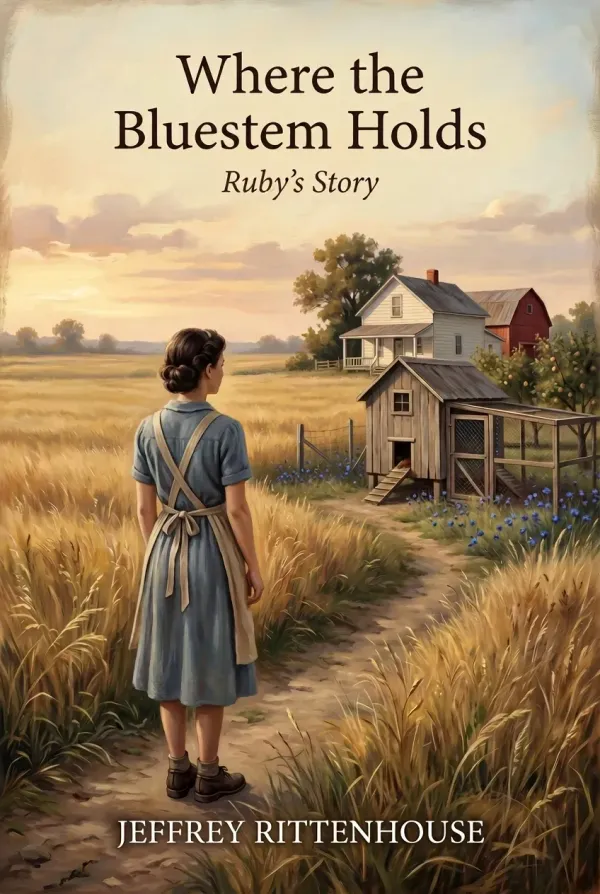
Free to read: the first chapter
Where the Bluestem Holds
Prologue
The wind on the Kansas prairie never learned to stay still. It came down out of the west the same way it had always come, bending the bluestem in long waves across the pastures and climbing the low hill behind the old Townsend house to move through the grass there, and on that hill there were more stones now than there had been when the place was new.
Raymond Townsend had built the house in the 1880s with a team of good horses and a conviction about this particular stretch of Kansas that the country gave a man very little sound reason to hold. He built a barn, a breaking corral, long pastures that he filled with half-Morgan, half-range horses, animals that could pull a plow or carry a rider thirty miles without complaint. He sold them all over the Midwest, and the money they brought built every improvement the farm ever had. For eight good years, he and his wife Sarah raised five children in that house, and it was as fine a life as the prairie offered.
Then 1891 came, and the prairie took what it had given.
A fire drove in from the west on a dry summer wind. Raymond drove his horses ahead of it so the family would have something left to live on. The horses lived. Raymond did not. He was buried on the hill behind the house under a wooden cross that stood for forty years before his family replaced it with cut granite, and most of the folks in Willow Creek assumed his wife, Sarah, would sell the place and go somewhere sensible. She did not sell. She kept the horses fed and the children fed and the farm running by some combination of stubbornness and faith that she never bothered to explain to anyone. She held the place through the long years after Raymond's death, the way bluestem holds through drought, bending flat in every hard season and coming back up after, the roots going deeper than the surface suggested.
Then a quiet horseman named Jacob Miller rode up the county road to buy a few yearlings, and he stayed to mend a fence, and then he stayed for good. He married Sarah the next summer under the big cottonwood beside the house, and he gave her five children, his name, and his steady years, and for a long run of good times, the place was full of children and horses and the sound of a family going about its work.
Children grew up and left. The new century drew the young toward cities, railroads, and everything the modern world was building. Elroy went to the railroads. Charlie became a doctor in the east. Shirley married a cattleman in Texas. Toby went to a college in New Hampshire to teach mathematics. They were good children, and they went.
Only Annie stayed.
She had been ten years old the summer of the fire, old enough to have her father's face in her memory and to understand what it meant when her mother did not cry in front of anyone. She grew up watching Sarah hold a broken thing together by will and by work, and she decided somewhere in those years that this hill and this grass were hers to keep. She married a steady man named Bruce Smucker, who had come to work the horses and stayed because Annie was on the place, and they made their lives together in the house Raymond had built, with Sarah and Jacob still there and the sound of horses in the pastures every morning.
Their daughter came into the world in 1908, a small, loud person with auburn hair and an opinion about everything from the first moment. Annie named her Barbara. Sarah called her Birdie before the week was out, and Birdie stayed.
Then, in 1918, the hard years came to the Townsend place, without asking. The influenza moved through Kansas the way fire moved, fast and without warning. Bruce Smucker came home from the railhead with the sickness already in him and did not get up from it. He was buried on the hill beside Raymond, and Annie held the farm the way her mother had held it, by not letting go. A quiet man named Sam Rosenburg came up the road some time after, looking for work, and he stayed the way Jacob had stayed before him, because that was what the right men did when they came to this place and found the woman on it. Annie and Sam made eleven good years together on the ground that had taken so much from her. Sam was buried on the hill in his time, and Annie not long after, and both of them with stones that said they had been loved and were not forgotten.
Birdie was the one who carried the place into the next hard era.
She had married a man named Earl in the years after the First World War, and they had two daughters, Ruby and Joanie. Then the Depression came in 1929 and took the money and took Earl not long after. A small child went with the hard years too, and that child's stone stood on the hill beside Earl's without a name that the family spoke aloud. In 1934, Birdie drove back to the farm with forty dollars, fourteen hens, and two daughters who needed a place to be, and she built something from that nothing that no one who saw the beginning of it would have predicted. She had come home a widow, and she came home under her own family name. She was Birdie Smucker again from the day she drove through the gate, and her daughters grew up Smuckers on Smucker ground, because the name belonged to the place and the place belonged to the name. She ran an egg cooperative across six farms. She sold preserves in cities as far as Kansas City. She held the Townsend place through the worst years the Kansas land had seen since Raymond's time, and she did it by the same method every woman in this family had used. She did not let go.
The good years of the late 1930s came on, slow and welcome. The girls grew up. Ruby, the older one, learned the farm's books the way she learned everything, carefully and completely, measuring twice before she put a number down. Joanie, the younger, tended a row of sunflowers along the south fence, added seeds to it every season, and never once questioned whether they would come up. They always came up. That was how Joanie understood the world.
Then 1941 came, and the prairie changed the terms again.
This time it was not fire, and it was not sickness. It was a war on the other side of the world that reached all the way to Willow Creek, Kansas, the way every hard thing reached the Townsend farm eventually, across five miles of open grass with nothing to stop it. The young men of the county went. Boys Ruby had grown up knowing, boys she had traded words with at the general store and raced against at the Fourth of July, put on uniforms and got on trains. Some of them did not come back. The ones who did not come back had their names added to the list in the post office window, where everyone in Willow Creek read them and then looked away.
The farm ran short of hands. The wheat still had to be planted. The wheat still had to come in.
In the summer of 1943, Ruby Smucker was sixteen years old, the same age her grandmother Annie had been when she decided this ground was hers to keep. She was tall and straight-backed and careful with numbers and not given to saying what she felt until she could no longer hold it in. She had her great-grandmother Sarah's auburn hair and her mother Birdie's steady eyes, and she had a face she had put on the enemy, a face that belonged to a boy from Willow Creek named Henry Marsh who had traded her hard candies for help with his arithmetic and had died in the Pacific in the spring and was not coming back.
She did not know, on the ordinary June morning when the Army truck came up the county road with three German prisoners in the back, that the prairie was about to give something back.
She did not know what kind of gift it would be.