Free to read: the first chapter
Where the Bluestem Bends
Prologue
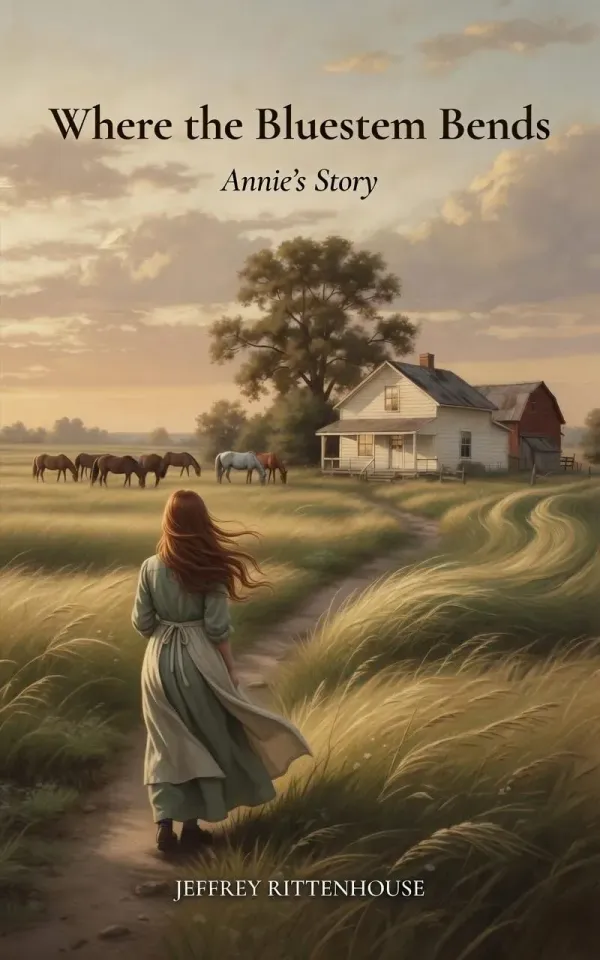
The wind on the Kansas prairie never did learn how to rest. It came down out of the west the way it always had, bending the bluestem in long green waves that ran clear to the edge of the sky, and it climbed the low rise behind the old Townsend house and moved through the grass that grew over the graves there.
For twenty-seven years a single wooden cross had stood on that hill. The weather had worked at it season after season until the wood went the soft gray of an old fence rail, but the family kept it standing, and every spring the bluestem came up thick and green around its foot. The man who lay beneath it had built the house with his own hands and raised it against this same wind. His name was Raymond Townsend, and he had died on a summer evening in 1891, driving his horses ahead of a prairie fire so that his wife and children would have something left to live on. The fire took him. It did not take the farm. That was the bargain the prairie made with the people who stayed on it, and the Townsends had learned to live by its terms.
Raymond left a wife and five children and a barn full of half-broke horses. Sarah Townsend was thirty-two that summer, and the folks in Willow Creek were sure she would sell the place and move to town, the way a sensible widow ought to. She did not sell. She buried her husband on the hill, and she kept the horses fed, and she raised her children through drought and blizzard and the long ache of going on alone.
Then a quiet horseman named Jacob Miller rode up the road to buy a few yearlings, and he stayed to mend a fence, and then he stayed for good. He had lost his own wife and little girl to a fever years before, and he knew the shape of grief the way some men know the weather. He married Sarah the next summer under the big cottonwood, and he gave the five children his name and never once treated a one of them as anything but his own. They learned to call him Pa. He taught the boys to gentle a colt and the girls to read a horse’s ears, and for a long run of good years the place was full of children and laughter and the steady work of raising fine animals on hard ground.
Children do not stay children, and they do not always stay on the land that made them. The new century came on, and with it the railroads and the automobiles and a hundred reasons to go. Elroy, the oldest, the boy who was meant to run the farm, went to the railroads instead and spent his days laying out the iron roads that were stitching the country together. Charlie became a doctor and went east to Philadelphia. Shirley married a cattleman and went south to a wide brown ranch in the Texas Panhandle. Toby, the baby, the one who had ridden Jacob’s shoulders before he could walk, turned out to have a head for numbers and went all the way to a college in New Hampshire to teach them.
Only Annie stayed.
She had been ten years old the summer of the fire, old enough to remember her father’s face and the smell of the smoke and the sound her mother made that did not come again. She grew up watching Sarah hold a broken thing together by main strength and quiet faith, and somewhere in those years she decided that this hill and this grass and these horses were hers to keep. She married a steady man named Bruce Smucker, who had come to work the horses and stayed to love her, and they had a daughter. The girl’s given name was Barbara, but she had come into the world talking and never stopped, and her grandmother had called her Birdie before she was a week old, and Birdie she stayed.
So the place went on. Five people now in the old house where there had once been seven. Sarah with her gray hair and her straight back. Jacob slower than he used to be, his hands still sure on a lead rope. Annie and Bruce in the middle of their lives, and a small girl chasing the barn cats through the bluestem. The horses still grazed the long pastures like living gold. The wind still came down out of the west. And the old black stallion called Raymond’s Star, foaled the spring after the fire, grazed off by himself now, gone gray about the muzzle, the last animal on the place that remembered the founding.
It was 1918, and the world had gone to war. The young men of Willow Creek had been called up and sent across the sea to fight in France, and the whole country bent itself to the work of it, buying bonds and going without and watching the road for the mail. Out on the Kansas plains the Army had raised a great camp at Fort Riley, and the soldiers’ city that grew up there they called Camp Funston, and thousands of farm boys passed through it on their way to the war.
That winter something else passed through the camp. It started small, the way a prairie fire starts small, a cough here and a fever there among men packed close in the cold barracks. The doctors called it influenza and did not yet know what they were looking at. By the time the grass began to green in the spring of 1918 it was moving, carried on the trains and in the soldiers’ coats and on the wind itself, out across the country and back into the quiet places that believed themselves too far from anywhere to be touched.
The Townsend place was five miles from its nearest neighbor and ten from town. It had always been a long way from the trouble of the world.
It would not be far enough.
On the hill the gray cross stood in the new grass, and the meadowlarks came back to sing the way they did every spring, and Annie went about her work not knowing that before the bluestem grew tall the ground beside her father would be opened again, and again, and once more after that. The prairie was getting ready to take. It would take more than she believed she could stand to lose.
But the prairie gives back too. It always does, in its own slow time, if a body can find the strength to stay and see it. Annie’s mother had learned that on this same hill a long time ago, after the fire.
Now it would be Annie’s turn to learn it, after the plague.