Free to read: the first chapter
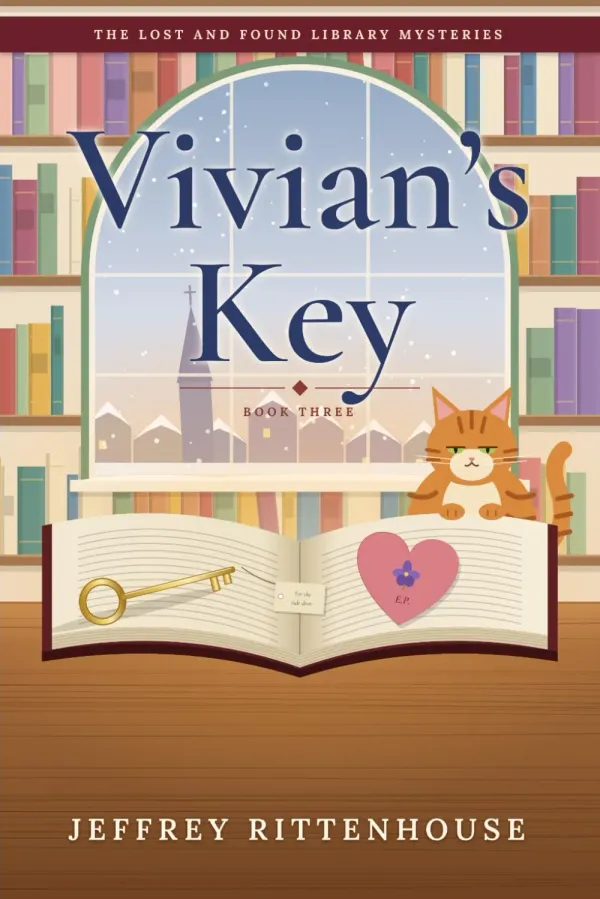
Vivian's Key
Chapter One
Vivian Bauer took her tea with two sugars and no milk, and she did not drink it.
She held the cup in both hands the way you hold something warm on a cold platform waiting for a train, and she looked around Margaret's kitchen as if she were memorizing it for a test. The yellow curtains. The calendar from the Millbrook Fire Company with December's picture of a ladder truck in the snow. Daniel's reading glasses, which had been on the windowsill over the sink for eleven years because Margaret had never decided where else they ought to go. Mr. Darcy, on the chair at the end of the table, looking back at her with his ears slightly flattened, the way he looked at the vacuum cleaner.
"He doesn't like me," said Vivian.
"He doesn't like anyone. He tolerates me because I have the can opener."
"Helen had a cat like that. Gray one. She called him Mr. Gruber, after the doctor, because he had the same expression." Vivian set her cup down on the tablecloth, very carefully, in the exact center of the saucer. "I'm sorry. I said I'd tell you a long story, and here I am telling you about cats."
"Cats are fine," said Margaret. "I like cats."
She found she meant it. She had pictured this moment so many ways since the Saturday before Christmas, when the old woman by the coffee urns had laughed and vanished, and in every version there had been a great deal of crying and some kind of speech. She had not pictured a small person in a raincoat much too big for her, sitting in Daniel's chair at a quarter past seven on Christmas morning with snow melting off her knitted hat onto the floor, talking about a cat.
The covered bridge tin sat on the table between them, its lid off. Dot Gerhart's whoopie pies, six of them, the filling split on every one.
Margaret had taken one to be polite. She was on her second.
"She makes them for the egg customers," said Vivian, watching her. "Every Christmas, Dot told me. She leaves a tin on the porch for each of us. I'm the newest egg customer, so I'm last on the route." She almost smiled. "I know something about routes."
"The bookmobile."
"Fourteen stops. Kemp farm first, nine o'clock sharp, or Mrs. Kemp would stand in the lane with her watch out." Vivian turned the saucer a quarter turn, then back. "You've been in the basement. Tom told me. You found the logs."
"Yes."
"Then you know more about my twenties than anyone alive." She said it lightly, but her hands had gone still on the saucer. "I wrote everything down in those books. Mrs. Pruitt said a driver's log was a legal document and I wrote in it like a diary. She used to read them on Friday afternoons and laugh. Eleanor Pruitt had the best laugh in Millbrook and almost nobody ever heard it."
Margaret thought of the stern woman in the cardigan who had held up Make Way for Ducklings and asked her if she was sure. She had never once heard Mrs. Pruitt laugh. She had not known Mrs. Pruitt could.
"Tell me about her," she said.
So Vivian did.
She told it well. Margaret had known she would, from the logs: the quick eye, the joke tucked into the end of a sentence where you didn't expect it. She told about the day in 1964 when she had walked into the library at eighteen to ask for a job shelving, and Mrs. Pruitt had looked at her over her glasses and handed her a stack of returned books and said, Put those away, and then watched her do it. Every one in the right place. Mrs. Pruitt had taken the stack back, pulled out The Robe, and said, This goes under D for Douglas, not under R for Robe, and if you ever do that again, you're fired, and you're hired. Start Monday.
She told about the green truck, bought used from the county in 1965, with a radio that only got one station out of Allentown and a heater that worked when it felt like it. About learning to back it up the Kemps' lane in the mud. About the Fritz boy at the trailer park who tore a page out of Treasure Island and then lied about it with such style that she let him keep his card.
And she told about Helen.
Not much. A little at a time, the way you'd test ice. Helen walking down Church Street after choir with her arm through Vivian's. Helen at twenty, quiet and careful, laughing so hard at something Vivian said in the vestry that the pastor came out to see if somebody had fallen. Helen, who could make a pie crust you could read the newspaper through. Helen, who sang alto and always on key and never once, in all those years, told her younger sister she was flat, though she was, terribly.
"She just put her elbow in my ribs," said Vivian. "Every single hymn. I had a bruise there from 1958 to 1968."
Margaret laughed. She couldn't help it.
And Vivian, across the table, went very still, and looked at her, and Margaret saw something cross the old woman's face that she could not name. It was there and gone, like a car's headlights sweeping across a ceiling at night.
"You laugh like her," said Vivian quietly. "When she was young. I wrote that to you once."
"In the letter. I know." Margaret looked down at her tea. "I don't remember her laughing like that. I don't remember her laughing out loud at all. She'd put her hand in front of her mouth."
Vivian said nothing for a moment.
"Well," she said at last, in a different voice, brisker. "People change."
It was the first door Margaret had felt close. She noticed it, and she noted the place, the way she would mark a shelf where a book had gone missing, and she let it go.
The kitchen clock said ten past one when Vivian stood up.
They had talked for nearly six hours. Margaret had made more tea twice and toast once and had not noticed the time go at all. The snow had stopped. The light coming through the yellow curtains had turned the color of weak butter. Mr. Darcy had given up on hostility and gone to sleep on the radiator.
"I'll go," said Vivian. "You've got somewhere to be."
"How do you know that?"
"Because you've looked at that clock six times in the last half hour and you've got your good blouse hanging on the pantry door with the tag still on." Vivian buttoned her raincoat, wrongly, one button off all the way down. "Bea Kowalski's Christmas dinner. Dot told me. Dot says everybody in Millbrook goes."
"You could come."
"No." She said it gently but at once. "Not yet. Half of those people knew me when I had red hair. I'm not ready to be looked at." She picked up her knitted hat and turned it in her hands. "Margaret. I haven't told you anything yet. You know that."
"I know."
"I'm going to. But I'd like to do it in order. From the beginning. The way I'd tell a story to somebody at the Kemp farm on a Tuesday." Vivian looked at the hat. "It's a long story, and the end of it is the hardest part, and if I start with the end I don't think I'll get through it. Can you let me do it my way?"
Margaret thought about it. She thought about fifty eight years of quiet in a house across town, and a month of carrying a blue envelope in her handbag, and a key in the book drop on Christmas Eve. She thought she had earned the right to ask for the end of the story first.
Then she looked at the old woman in the big raincoat, buttoned wrong, and thought that Vivian had probably earned something too.
"Your way," she said.
Vivian let out a breath.
"Sundays," she said. "If that's all right. Sunday afternoons. I'll bring the next piece."
"Next Sunday's the twenty seventh."
"Then the one after. I've got a cold coming on, I can feel it in my ears, and I'll need New Year's to get over it." She put on the hat. "The third. Two o'clock."
At the front door she stopped. Out at the curb, coming slowly down the plowed street with its headlights on in the middle of the afternoon, was a green Buick.
Vivian looked at it. Then at Margaret.
"Frank Dombrowski," she said. "Detective. Bets fifty dollars against himself." Her mouth turned up at one corner, the gap in her teeth just showing. "Dot tells me everything. Merry Christmas, Margaret."
And she went down the steps and along the walk, small and quick in the snow, and turned the corner onto Walnut Street before the Buick reached the curb, and was gone.
Margaret stood in the doorway. Frank got out of the car in his good gray suit and his overcoat, with a box from the bakery in Kutztown under one arm, and came up the walk, and stopped at the bottom of the steps.
"Who was that?" he said.
"Nobody," said Margaret, and then, because it wasn't true and he would know it wasn't, "Somebody. I'll tell you later."
He looked at her a moment longer, the way he looked at a crossword clue he had decided to come back to.
"Two o'clock," he said. "You've got a tag on your blouse."
She did. She went in and cut it off with the kitchen scissors, and put on her coat, and let him drive her to Bea's.
Bea's Christmas dinner was loud and hot and smelled of turkey and filling and the coffee Darlene made in the big urn. Walter carved again. Oliver said grace and thanked God for Buster, for Mrs. Hale's library, for Santa Claus and for the snow on Christmas Eve, which God had apparently arranged. Gus wore a tie. The Hartleys came, and Kim Schaeffer, and Ronnie Gehris, who told everybody he had been present the day Bea took over the diner, which nobody bothered to dispute.
Margaret sat between Frank and Susie and ate everything Bea put in front of her and said nothing at all about the old woman in the raincoat.
It was Susie who noticed, of course. Susie noticed everything.
"You're doing the thing," she said, under the noise, around a mouthful of sweet potato. "The thing where you're here but you're not here."
"I'm here."
"You've buttered that roll twice."
Margaret looked down. She had.
"I'll tell you," she said. "Not today."
"Is it good or bad?"
Margaret thought about Vivian's face when she laughed, the thing that had crossed it and gone.
"I don't know yet," she said. "Ask me in a few weeks."
Susie looked at her, and then nodded, and passed her the cranberry sauce without being asked, which for Susie was a kind of promise.
Across the room, by the pie case, Bea had propped up the betting board on its easel. Under BY VALENTINE'S, in a small, square hand, it said F.D., $50.
Margaret did not look at it. Frank did not look at it either. They ate their pie side by side, very carefully not looking at it, and Bea watched them both from behind the counter with the satisfied face of a woman who had seen this movie before and knew how it ended.