Free to read: the first chapter
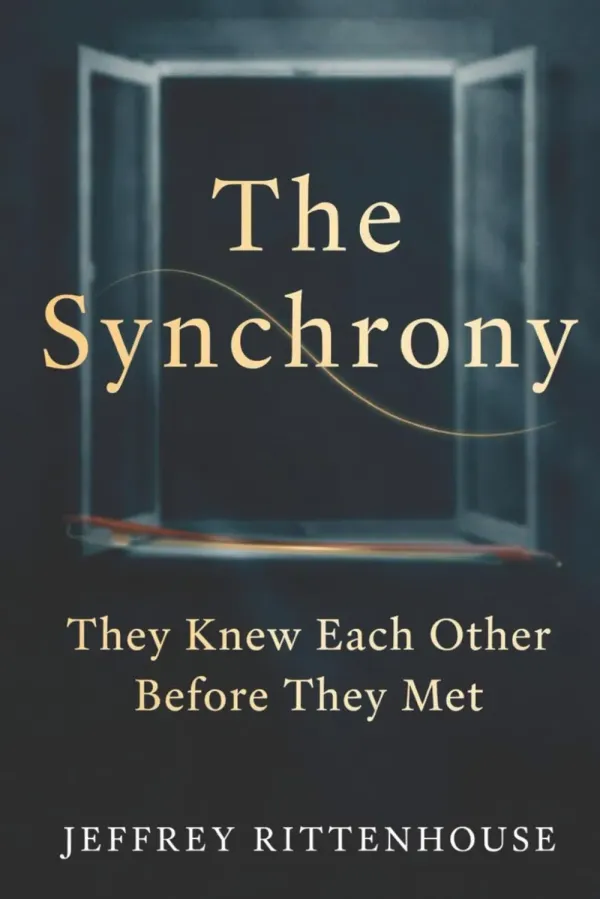
The Synchrony
Prologue
The boarding pass had been in his hand for twenty-three minutes.
Gate 42. Philadelphia. Departure 09:15.
Édouard sat in a plastic chair at Charles de Gaulle with his carry-on bag between his feet and the pale October light coming through the terminal's high windows, and he looked at the boarding pass the way you look at a decision you have already made but not yet fully absorbed. Around him the airport moved in its ordinary, indifferent way. A woman dragged a suitcase that was obviously too heavy and refused to acknowledge it. A child pressed his face against the observation glass and watched a plane taxi toward the runway with the concentrated wonder that only the very young bring to ordinary things.
He had not told her he was coming.
He had told only Sébastien, who had responded with a silence more eloquent than anything he might have said. It was the silence of a man who had been patient for a very long time and was watching his patience quietly become unnecessary.
The gate agent's voice came over the speakers. Final boarding call for flight AF 736 to Philadelphia.
Édouard looked at the boarding pass one last time.
Then he stood, picked up his bag, and walked toward the gate. He did not allow himself to think too carefully about what he was doing, because thinking too carefully was the thing that had cost him everything once already.
He did not let himself think about her face when she opened the door.
Chapter One
The Dvorak was not cooperating.
Edna Phillips had played the Cello Concerto in B minor approximately four hundred times in her life, a conservative estimate, and there were passages in the first movement she knew the way she knew her own heartbeat. Intimately. Without having to think. Tonight she was thinking. She had been in Practice Room 4 at the Kimmel Center for two hours, working the same sixteen bars over and over with a patience that had somewhere along the way become stubbornness, and the passage was still not giving her what she wanted. It was technically correct. It was precisely, boringly, uselessly correct. It had all the emotional life of a form filed in triplicate.
She stopped. Lifted her bow from the string. The room settled into the particular silence of a place that had just contained music and was now remembering it.
Edna sat back in her chair and looked at the music stand without seeing it. Through the practice room's small window the lights of Broad Street made their usual irrelevant display. It was a Tuesday in late September, a quarter to eight in the evening, and she had a rehearsal tomorrow morning at ten and a performance Thursday night and she was, by any reasonable measure, exactly where she had worked her entire life to be. She was trying to decide whether that thought was comforting or not when it arrived.
Not gradually. Not the way your own feelings arrive, building from somewhere recognizable, connected to something you can trace back to its source if you follow it far enough. This arrived the way a door blows open in a room you were certain was sealed. A grief so complete and so specific that it stopped her breath entirely. Not sadness, not the low grey of melancholy, nothing so general as that. This was the grief of a particular loss. The grief of something loved and gone and irretrievable, something that had been carried quietly for years until this moment when it broke the surface without warning.
It pressed against the inside of her chest with a weight that was not hers.
Edna sat completely still.
She was not grieving. She had not been grieving thirty seconds ago. There was nothing in her life at this moment that warranted this, nothing lost, no one gone, no wound recently reopened. She had eaten dinner with Daniel on Sunday and it had been pleasant. She had called her mother that same afternoon and the call had been fine, the usual fine, the fine that meant nothing more than fine. She had walked through the Square that morning and the trees were doing what September trees do and she had felt the ordinary low pleasure of a city morning.
And yet here it was. Filling her the way water fills a low place in the ground, finding every hollow, leaving nothing untouched.
Her bow was still in her hand. She set it carefully across her knee.
She had always felt things more than other people. She had been told this her whole life in tones that ranged across the full spectrum from concerned to admiring to simply exhausted. She knew her own emotional landscape with the intimacy of long habitation. She knew what her grief felt like, what her sadness felt like, the specific texture of her loneliness and her joy and the particular brand of anxiety that arrived uninvited at three in the morning and sat with her until the light came. She knew all of those things. She had lived inside them for twenty-six years.
This was none of those.
This was someone else's.
The thought arrived so cleanly, with such complete and unargued certainty, that she did not question it. Which would seem strange to her later, how little she resisted the idea, how naturally it settled into her like a thing that had always been true and was only now being named. Someone else's grief. Someone else's specific, years-old, carefully tended pain, breaking the surface for just a moment on a Tuesday evening, and arriving here, in a practice room in Philadelphia, in the chest of a woman who did not yet know what to do with it or where it had come from or how far it had traveled to find her.
She sat with it. She did not try to push it away.
After a while, she couldn't have said how long, it began to recede. Slowly, the way water pulls back from the shore after a wave, reluctant and unhurried. Her own breath came easier. The room reasserted itself around her. The music stand. The window. The faint sound of someone running scales two rooms down the hall, the same ascending figure repeated patiently into the quiet building.
Edna looked down at the cello in her lap.
She thought about writing it down. Then she thought about not writing it down, about chalking it up to exhaustion or low blood sugar or the particular atmospheric weight of a September night. These were sensible explanations. She was, when it suited her, a sensible person.
She picked up her bow.
She found her place in the Dvorak and played the passage again from the top.
This time it sang. Something had shifted in her chest, some door left open that had been closed before, and the music moved through it the way music moves through a person who has stopped managing themselves long enough to feel something true. She played to the end of the phrase and then the next and then the next. She played until the building went quiet around her and the lights on Broad Street changed colour in the dark and she finally set the cello down with both hands and sat in the silence for a long moment, not thinking about anything at all.
She walked home through the Square. The September air was cool and the trees held the last of the day's warmth in their leaves and the city was doing the thing it does in early autumn when everything contracts slightly, pulling inward toward itself, toward the long interior season ahead. She walked with her cello case across her back and her hands in her jacket pockets and she looked at the people she passed the way she sometimes did after a long practice, with a kind of opened attention, as though the music had temporarily removed the usual film between herself and the world.
She wondered whose grief it had been.
She wondered if they were all right.
She unlocked her apartment door, set her cello in the corner by the window, filled a glass of water in the kitchen, and stood at the counter drinking it in the dark. Through the window across the narrow gap between buildings, her neighbor's kitchen was lit and empty. The radiator ticked once and went still.
Edna set down her glass.
She went to her bedroom and found the journal she kept in the drawer of her nightstand, the one she wrote in rarely and without any real system, only when something happened that she did not want to lose before she understood it. She opened it to a blank page. She wrote the date. She wrote the time, a quarter past nine. She wrote: Something arrived tonight that wasn't mine. I felt it as clearly as I have ever felt anything. A grief. Old and specific. Someone's. Not everyone carries something like that, quietly, for years.
She looked at what she had written.
Then she wrote one more line: I hope they are not alone with it.
She closed the journal. She turned out the light. Outside, the city carried on in its ordinary and unknowing way, and six hours ahead of her, across an ocean she had not yet crossed, a man named Édouard Manet sat in a café in the sixth arrondissement with a coffee going cold in front of him and no idea at all why he suddenly felt, for the first time in a very long time, that somewhere in the world someone was thinking of him with great tenderness.