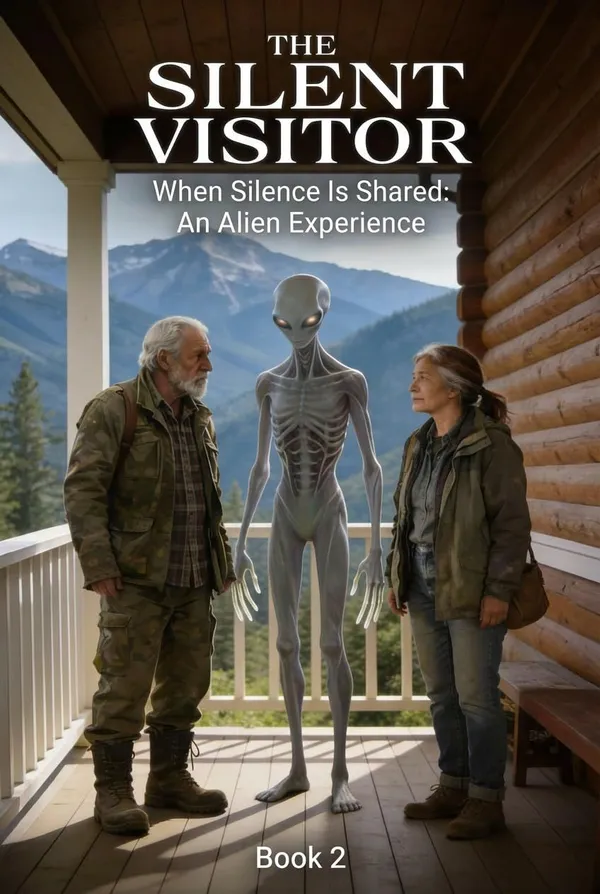
Free to read: the first chapter
THE SILENT VISITOR When Silence Is Shared
Chapter 1After the Silence
The mountains didn’t care that anything had changed.
Morning still came the same way it always had—slow light spilling over the ridgeline, mist caught in the lower hollows, pine branches dripping with whatever the night had left behind. The creek still ran cold and stubborn. The wind still tested the trees as if it were bored.
John Carter stood on his porch with a mug of coffee cooling in his hands and watched the world do what it always did.
It was the only thing that made sense.
Inside the cabin, the air was warm from the stove. Everything was where it belonged—the chair by the window, the old table marked by decades of use, the rack of tools that made a man feel useful even when his life had turned into something he couldn’t explain to anyone alive.
But the cabin felt larger now.
Not in space. In absence.
Xylar had been gone long enough that John’s mind no longer expected to feel him in the corners of a room or in the quiet between thoughts. John no longer felt the steady, calm pressure of another presence sharing the same silence.
That was the worst part.
Not the fear. Not the risk. Not even the responsibility.
It was the emptiness where something steady had been.
John took a slow sip of coffee and let the bitterness settle. His body felt strong, as it had since the gift. The old pain that used to announce itself in his knees and shoulders was still absent, and some mornings that felt like mercy.
Other mornings it felt like a reminder.
He set the mug down on the porch rail and exhaled.
“Alright,” he said softly, to no one. “We keep going.”
The routine started immediately. It always did.
He walked the perimeter of his land, boots finding familiar stones even when the ground was half-frozen. He checked the fence line and the trail markers, not because he expected damage but because consistency was part of the camouflage. A man who did what he always did was a man who didn’t invite questions.
The watchers were out there somewhere.
John didn’t need to see them to know.
He felt them the way he felt a coming storm—a pressure spread wide and patient, never intrusive, never absent. Sometimes it hovered at the edge of his awareness like an unanswered question. Sometimes it faded so completely he wondered if he’d imagined it—until he realized he’d been breathing easier in the silence, like the world had been allowed to soften for a moment.
He had learned not to speak to them unless there was a reason.
Talking to emptiness wasn’t what made a man look strange.
It was expecting emptiness to answer back.
By late morning, he drove into town.
The trip wasn’t necessary every week, but it was useful. People expected to see him now and then. His habits were part of his disguise.
The road down the mountain wound through bare trees and patches of lingering snow. The town came into view gradually, roofs and signs and thin lines of smoke from chimneys. Nothing about it looked like it belonged to the same universe as the one John had touched.
That was fine.
The general store bell chimed when he entered, and the warmth hit him first—heat and light and the smell of bread near the counter.
Sarah Whitman looked up from a clipboard and smiled.
It wasn’t a big smile. Sarah didn’t waste expression. But her eyes softened in a way that made the whole room feel steadier.
“Morning, John,” she said.
“Morning.”
She set the clipboard down and leaned her elbows on the counter, studying him the way she always did—quietly, as if she was checking whether the world had shifted again and John had noticed first.
“You’re early,” she said.
“Couldn’t sleep,” John replied.
Sarah’s gaze held his for a beat too long.
Then she nodded, as if she understood exactly what he meant.
“You want the usual?” she asked.
John glanced toward the back where the coffee sat in a pot that looked older than both of them combined. “If it’s not burnt.”
“It’s always burnt,” she said dryly. “That’s what makes it dependable.”
He took a cup and stood near the front window, watching a man load groceries into the back of a truck outside. Normal things. Ordinary motions. People living their lives without any idea how close the world had come to being something else.
Sarah moved around behind the counter, restocking items with the practiced calm of someone who had managed a small town’s small emergencies for years. When she spoke again, her voice was low.
“You’ve been up the mountain a lot,” she said.
John didn’t turn. “That where I live.”
“That’s not what I meant.”
He looked over at her then. Sarah was watching him with that steady patience that could feel like kindness or pressure depending on whether you had anything to hide.
John had always had something to hide.
Not from her.
From the world.
“I’ve been busy,” he said.
Sarah nodded once, accepting the answer but not believing it was the whole one. She didn’t call him out. She never did.
Instead, she poured herself coffee and came to stand beside him, facing the window so she didn’t have to look at him directly.
“People say you look… better,” she said.
John huffed a quiet laugh. “People talk too much.”
“People notice patterns,” she corrected.
John felt the familiar tightening in his chest—not fear, but caution. He didn’t want to become a pattern. Patterns got examined.
Sarah sipped her coffee. “I’m not trying to corner you, John.”
“I know.”
Her voice softened. “Just checking in.”
John swallowed. Checking in. The simplest act of human care. It shouldn’t have felt so heavy.
He nodded once. “I’m alright.”
Sarah’s gaze flicked to him. “That wasn’t my question.”
John looked at her, and for a moment he almost told her everything.
Not about the crash. Not about the watchers. Not about the gift.
Just the simple truth:
He was tired of holding the silence alone.
But the silence wasn’t his to give away. Not yet.
“I’m managing,” he said.
Sarah’s expression didn’t change, but something in her eyes shifted—acceptance, and a quiet sadness that mirrored his.
“Okay,” she said. “Then manage this.”
She reached under the counter and handed him a paper bag—fresh bread and a small container of soup, still warm.
“I didn’t order this,” John said.
“I know,” Sarah replied. “That’s why you’re taking it.”
John stared at the bag for a second, then shook his head like he was annoyed—but he took it.
“Thank you,” he muttered.
Sarah’s mouth quirked. “Don’t make it weird.”
John almost smiled. Almost.
He paid for his supplies, nodded at a couple locals who nodded back, and stepped outside into the cold.
The air felt sharper after the warmth of the store. The sky was bright, clean, indifferent. The world kept moving the way it always did, and John let himself pretend—just for a moment—that he was part of it without exception.
Then the pressure returned.
Subtle. Wide. Patient.
The watchers.
John stiffened slightly, but kept his face neutral. He loaded his supplies into the truck, moved with the same unhurried steadiness anyone would expect from him.
He didn’t look up.
He didn’t acknowledge them.
But as he shut the truck door, he spoke under his breath anyway—not to the sky, not to the stars, but to the thing he could no longer deny.
“I’m still doing it,” he said quietly. “I’m still holding.”
He waited—just a beat.
Nothing answered.
That was the rule.
John climbed into the truck and drove back toward the mountain, the town shrinking behind him in the rearview mirror.
The road rose, trees thickening. The familiar solitude returned.
Only this time, it didn’t feel like peace.
It felt like a duty.
John reached the cabin by late afternoon. He carried the groceries inside, set the bread on the table, and stared at it for a long moment as if it were proof that he hadn’t imagined the warmth of the world below.
He ate slowly. He repaired a loose hinge on the back door. He sharpened a knife that didn’t need sharpening. He did small tasks because small tasks were honest.
As dusk came on, he stepped out onto the porch again.
The mountains darkened. The stars began to show, one by one.
And then—faintly—he felt something else.
Not the watchers’ wide attention.
A narrower presence, distant but familiar in shape.
Like a voice held just beyond hearing.
John’s breath caught. He didn’t reach. He didn’t demand.
He simply stood there and let the feeling exist.
The presence drifted, hovered, then faded.
John released a slow breath.
So Xylar was still near enough to know.
Near enough to listen.
Not near enough to intervene.
John nodded to himself once, the way a man does when he understands that the road ahead hasn’t changed—only the fact that he would have to keep walking it.
He turned back toward the cabin.
Tomorrow would come.
And after tomorrow, there would be more quiet days, more careful choices, more moments where fear tried to become action.
John Carter would meet them the same way he always had:
With restraint.
With patience.
And with the steady, human decision to keep the silence from becoming something that broke the world.