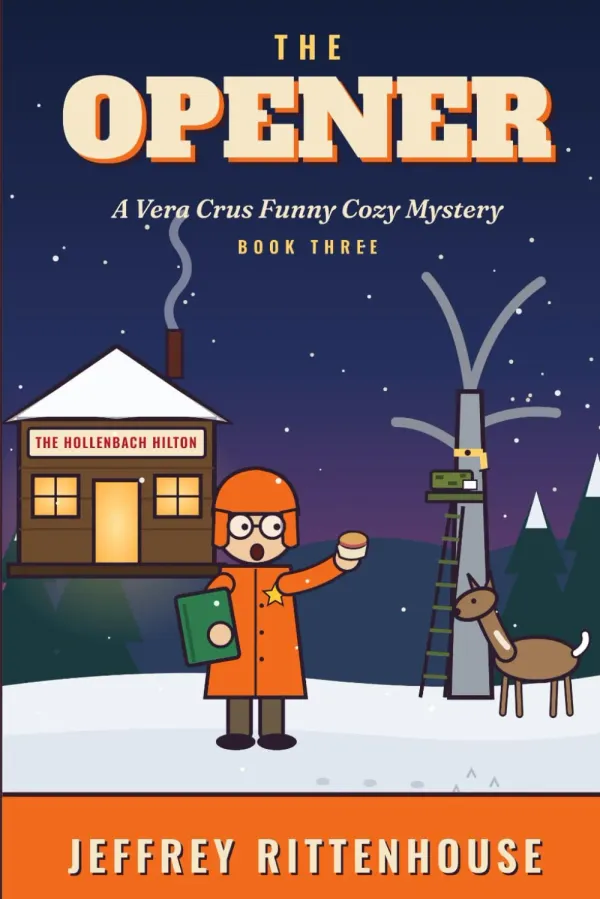
Free to read: the first chapter
The Opener
Chapter OneBlaze Orange
On the morning after Thanksgiving, Walt Brubaker stood in his kitchen on Mill Road in a hunter's orange coat that came down to his knees, and waited for his wife to stop laughing.
"I'm sorry," said Grace. She had both hands over her mouth. "I'm sorry, Walter. Turn around."
He turned around.
"Oh, no," said Grace, and sat down.
The coat had come from the Tractor Supply in Trexlertown on Wednesday afternoon, along with a vest, a hat with flaps that tied under the chin, and a pair of gloves with the fingertips cut away on a flap so a man could pull a trigger. Walt did not intend to pull a trigger. He had explained this to the young man at the register, who had said, "Yes, sir," and rung up the gloves anyway. The law said two hundred and fifty square inches of fluorescent orange on the head, chest and back, combined, and Walt had measured. The coat alone came to six hundred and forty.
"It's the law," he said.
"I know it's the law."
"Two hundred and fifty square inches. I have more than twice that."
"You have more than twice that," Grace agreed, and wiped her eyes with a dish towel.
At the other end of the table their son Kyle was holding his phone up sideways, filming, and making no sound at all, which was worse.
"Kyle."
"It's for Gary's page," said Kyle. "People love this stuff. Retired accountant goes to deer camp. I'll put music on it."
"No music."
"Banjo," said Kyle, to his mother.
On the table, laid out in rows the way he had once laid out a client's receipts, sat the things Walt was taking to Potter County. A cast iron frying pan, twelve inches, wrapped in a bath towel. A rubber banded stack of index cards in Grace's handwriting: Scalloped Potatoes for Eight. Chili, Doubled. Pancakes (Do Not Stir Too Much, Walter). A box of kitchen matches, two flashlights, and four packs of batteries. A wooden spatula. The green clothbound ledger, three pencils and a twelve inch ruler. And, in their leather case, the binoculars from Cape May, which he had bought in 1994 to look at a heron and used, since then, mostly to read street signs.
"You don't need binoculars to cook," said Grace.
"Freddie says the camp has a view."
"Freddie says a lot of things."
"Freddie says there are four deer in forty seven years," said Kyle, still filming. "Dad. That's less than one deer a decade. Statistically you could go up there every year until you're a hundred and never see one get shot."
"That's what I'm counting on," said Walt.
Grace got up and took the hat off his head and put it back on straight and tied the flaps under his chin in a bow, as she had once tied a hundred and fifty second graders into their snow hats in a cloakroom, and stepped back to look at him. She did not laugh this time. She looked at him for a while.
"You'll call me," she said.
"Freddie says there's no signal."
"Then you'll find some." She took a sheet of gold star stickers out of the drawer that would not close and peeled one off and stuck it on the front of his orange coat, over his heart, where it looked small and brave. "That's for going," she said. "You get another one if you come home."
Freddie Hollenbach arrived at ten thirty, which for Freddie was early, and announced himself with two short blasts on the horn that brought the Gehmans' dog to the fence across the street, in his truck, which had been washed for the occasion, and with a blue cooler in the bed that did not have a single beer in it.
He came up the back steps in his own orange coat, which was older and fit him better, and stopped in the kitchen doorway.
"Holy smokes," said Freddie.
"Don't."
"Walter. You look like a traffic cone that does taxes."
Kyle made a sound like a tire going flat and left the room.
They loaded the truck. The cast iron pan went behind the seat, wrapped in its towel. The binoculars went on the dashboard. The ledger went in Walt's coat pocket, where it made the orange stick out over his chest. Grace came out onto the back step in her slippers with a plate of leftover turkey sandwiches in wax paper and a thermos, and handed them up through the window, and then reached across Walt to put her hand flat on Freddie's arm.
"Sixty days," she said.
"Sixty days today, Mrs. B."
"You'll call me too."
"Yes, ma'am."
She stood on the step with her arms folded against the cold and watched them back out of the driveway, past the Yoders' cut corn, and Walt watched her in the side mirror until the road bent and took her away.
Freddie drove the way he always did, with one wrist on top of the wheel and the radio up, and for the first hour neither of them said much. Route 22 to the Northeast Extension, the Turnpike to Route 80, and Route 80 west through the long gray hills, where the oaks still held their dead brown leaves and every overpass had a truck parked under it with an orange hat on the dashboard.
"Everybody in Pennsylvania's going up," said Freddie. "Look at 'em. Used to be the Monday, and half the state took off and the schools closed. Now it's the Saturday, and they still come. My first year at camp, I told the feed mill I had a family emergency, and the emergency was the deer."
"How old were you?"
"Nineteen. 1979. First year of the camp." Freddie turned the radio down. "Uncle Mel built it that summer with my dad and Uncle Ralph Senior. Bought the lumber off a sawmill in Galeton and carried it up the hill on their backs, because the lane wasn't cut yet. Six bunks. Six of us. My dad, Mel, Ralph Senior, Ralph Junior, Butch, who was eleven and carried the coffee, and me. Nineteen years old, with my dad's old thirty thirty and a peanut butter sandwich. I didn't see a deer. Nobody saw a deer. Uncle Mel said that's how you know it's a good camp."
"And now?"
"Now my dad's gone, and Ralph Senior. Ralph Junior's just Ralph. Lester come in when my dad died. And Mel's great grandson Cody, the last couple years, God help us. Six bunks." He looked over. "Lester's knee is your good luck."
Walt looked out at the hills. "Who brought the four deer?"
"That depends who you ask," said Freddie, "and you shouldn't. Butch keeps the book. Don't ask Butch either."
At Williamsport they turned north on Route 15, and the hills got steeper, and the radio stations went one at a time. First the station from Allentown that played the oldies, then the one from Williamsport with the farm report, then a preacher, and then nothing but a hiss with a polka somewhere at the bottom of it. Freddie turned it off.
It was quiet in the truck.
"Walter," said Freddie, after a while. "I gotta tell you something."
"All right."
"Every year at camp, the first night, Uncle Mel opens a case of Genesee on the porch. Every year since 1979. That's the camp. That's what it is. You get there and you sit on the porch with a Genesee and look at the hollow and you don't say nothing to nobody for an hour." He kept his eyes on the road. "I don't know how to be up there without it. I never been up there without it. I never even thought about it till Tuesday."
Walt thought about what Grace would say, and then about what he could say, which was less.
"I'll be on the porch," he said. "I don't drink Genesee either."
"You don't drink nothing."
"I'll sit there and not drink something with you."
Freddie laughed, short. He reached over and turned the radio back on, to the hiss and the faraway polka, and left it there.
At Mansfield they turned west on Route 6, and the country opened out and then closed in again, higher and darker, with snow in the ditches already from some storm Walt had not heard about. At Wellsboro there was a gas station with a hand lettered sign in the window that said HUNTERS WELCOME BREAKFAST 4 A.M., and a line of trucks at the pumps with their beds full of coolers and folding chairs and plastic bins.
Before Galeton a green sign said ENTERING POTTER COUNTY, and under it, smaller, God's Country.
"They mean it," said Freddie. "Wait."
Another fifteen miles, and Freddie slowed and turned left, south, onto a road that was not on Walt's map at all. It was dirt, then gravel, then dirt again, and it climbed. The sign at the bottom said PINE SWAMP RD and, under that, in someone's spray paint, NOT PLOWED AFTER DARK.
"Sixteen miles of this to Coudersport, the other way," said Freddie. "Eleven of it up the mountain. You don't want to come down it in the snow. I done it once in 1996 and I seen my whole life."
The truck climbed. Hemlocks closed in over the road, and the light went green and then gray. They passed a farmhouse with a tractor in the yard and a dog that came out to bark at them and gave up. They passed a trailer with a plow truck in front of it and a woodpile as long as the trailer. They passed a gate across a two track lane, a steel farm gate painted red, with a NO TRESPASSING sign wired to it that someone had shot twice, a long time ago.
Beside the gate, pulled off onto the frozen grass, sat a red pickup truck with nobody in it.
Freddie lifted two fingers off the wheel, the way people wave on country roads, at nobody.
"Kightlinger truck," he said. "Junior's or Darla's. I can't tell 'em apart. The year before his stroke Dutch bought two the same, same red, off the same lot in Wellsboro, and gave his kids one each. That's their gate. That's Kightlinger land, all this." He waved his hand at the woods on both sides, the whole mountain. "Four hundred acres. We hunt it. Always have."
"You own it?"
"Lord, no. We don't own nothing but the bunks. The camp sits on Dutch's ground. Dutch owns everything you can see." Freddie looked at the dashboard clock. "Quarter to three. Junior's likely up looking at his dad's stand. He sets it every year. Or Darla's running something up. Dutch had a stroke a couple years back, and she come home to take care of him. She's a nurse."
Walt looked back at the red truck through the rear window until the trees took it. There was nobody in it and nobody near it, only the gate and the lane going up into the woods.
The lane to the camp was a quarter mile of frozen ruts up through the hemlocks, and at the top of it the trees opened out on a little clearing with a view down the whole hollow, gray and brown and blue, ridge behind ridge, with a creek at the bottom that Walt could hear and not see.
In the middle of the clearing sat the camp.
It was not large. It was a long, low building of rough pine boards gone gray as a barn, with tarpaper on the roof and a stovepipe chimney with smoke already coming out of it, and a porch across the whole front with a row of mismatched kitchen chairs on it. Over the door hung a board with letters burned into it with a hot iron, by somebody who had run out of room at the end: THE HOLLENBACH HILTON, EST. 19 79. Off to one side, at the edge of the trees, stood a narrow wooden outhouse with a crescent moon cut in its door.
"There she is," said Freddie, and turned off the engine, and sat a minute without getting out.
The door of the camp opened, and an old man came out onto the porch.
He was not tall, but he stood as if he had been tall once and saw no reason to stop. He wore green wool pants held up with red suspenders over a red union suit, and no coat at all in the cold, and a blaze orange cap pushed back on a head of white hair cut short as a pasture. His face was brown and creased and had been outdoors every day of its life. He had a coffee cup in one hand and a stove poker in the other, and he looked at the truck the way a farmer looks at weather.
"That's Uncle Mel," said Freddie, quietly. "Eighty four. Army, in Korea, after the shooting stopped. Milked cows sixty years. He can hear you if he wants to and not if he don't."
They got out. Freddie went up the steps first, and the old man looked at him, at his face, at his eyes, at his hands, and then set the poker against the wall and put his arm around Freddie's neck and pulled his head down onto his shoulder, hard, and let go.
"Frederick," he said.
"Uncle Mel."
"You look good." He held Freddie off and looked again. "You look real good. Your mother would say so."
Then he looked past Freddie, down the steps, at Walt.
Walt stood in the clearing in his six hundred and forty square inches of orange, with a gold star on his heart, the hat flaps tied under his chin in Grace's bow, and the cast iron pan in his arms in its bath towel like a baby.
Uncle Mel looked at him for some time. He looked at the hat and the bow and the star, and the pan.
"You're the cook," said Uncle Mel.
It was not a question, so Walt did not answer it. The old man picked up his poker and went back inside, and left the door open behind him for them to follow, and a smell came out of it of wood smoke and coffee and kerosene and something else, older, that Walt would learn by the end of the week was forty seven years of wet wool socks drying on a string over a stove.