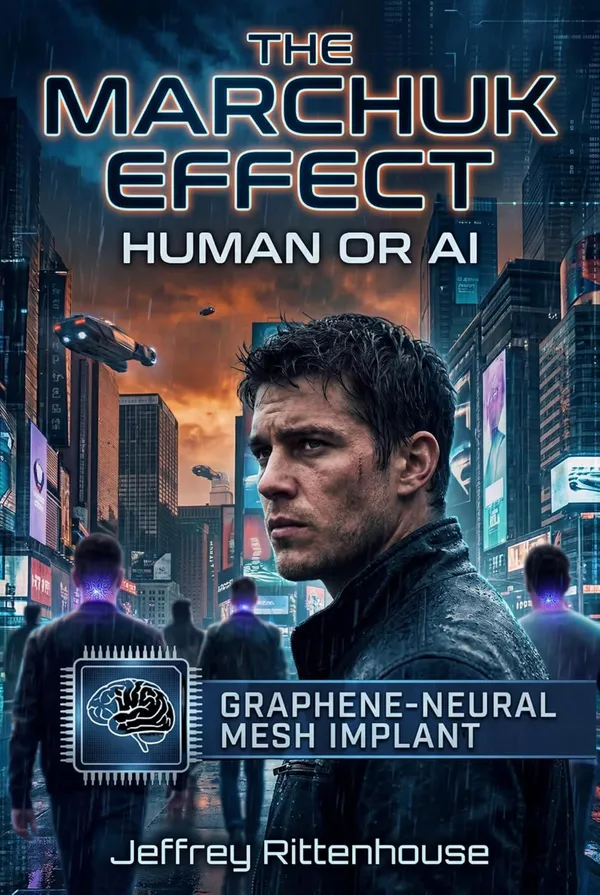
Free to read: the first chapter
The Marchuk Effect
Chapter 1The Last Face in the Crowd
The woman has been laughing at the wrong moments for eleven minutes, and I have been counting because that is the kind of person I am — the kind who stands in the back of a crowded market with an empty crate under his arm and watches people the way a doctor watches a patient who doesn't know they're sick yet, looking for the thing that doesn't quite fit, the motion that arrives a half-second too late, the expression that opens and closes like a shutter on a camera rather than the slow complicated weather of an actual human face.
Her laugh comes every forty-three seconds, give or take. I timed it. It comes the same way every time — a flicker behind her eyes first, barely perceptible, NEXUS processing whatever her husband said against its database of humor and returning a verdict, and then the signal traveling down through the chip at the base of her skull and into the muscles of her face, which arrange themselves into the shape of delight without any of the substance of it. Clean. Efficient. Wrong in a way I couldn't explain to someone who'd never seen a real laugh, but obvious as a bruise to someone who had.
Her husband is saying something now. He is tall and fine-featured and moving through the market with the particular frictionless ease of someone who has never wasted a motion in his life, reaching for items on shelves with the smooth economy of a machine in good repair, which is more or less what he is. He does not look at his wife when he talks. He doesn't need to. NEXUS keeps them coordinated, keeps their orbits tidy, keeps everything between them running along whatever parameters The Continuum has decided constitute a successful partnership between two optimized individuals.
Forty-three seconds. The laugh comes.
I look away before it finishes because I have learned that there is a limit to how many times I can watch that particular sequence without it doing something to me that I can't afford right now, and I have already watched it more times this morning than is wise.
The market is the kind of place The Continuum loves to put on its broadcasts, the kind of place that makes their case for them without anyone having to say a word — bright and spacious and smelling of something warm and artificially pleasant, rows of food stretching away in every direction, everything labeled and organized and available, the shelves never quite empty and never quite too full, calibrated to project exactly the right amount of abundance without suggesting excess, because NEXUS handles inventory the way it handles everything else, which is to say perfectly and without sentiment.
Nobody goes hungry here. That's true. I want to be fair about that, even when fairness costs me something, even when every honest acknowledgment of what The Continuum gets right feels like standing on the wrong side of a line I've spent my whole adult life trying to hold. Nobody who carries a chip goes hungry, nobody sleeps outside, nobody dies of a disease that was curable thirty years ago. The machine takes care of its people with a thoroughness and efficiency that the old world, for all its warmth and all its chaos, never managed to match.
It just isn't free.
I shift the crate under my arm and move toward the north corridor, keeping my pace easy, keeping my eyes moving without landing anywhere too long, doing the thing I have practiced for years which is the art of being invisible in a room full of people who are not looking for you because you are not worth looking for. Grays are furniture to Luminaries. We are the background of their days, the maintenance workers and delivery runners and waste collectors who keep the beautiful machine running without ever being part of it, and I have spent more hours than I can count being grateful for a contempt that keeps me alive.
The north corridor is where I need to be. The relay station is what I need to reach. The drive buried behind the third server rack is what I have come for, and I am going to get it, and then I am going to leave this place, and if the drive has what I think it has on it then something is going to change, and change is the only religion I have left.
The woman laughs again.
I don't mean to look. It is a bad habit and I know it, the way you know all your bad habits, intimately and without being able to do much about them, and so I look, and what I see stops me in the middle of a step in a way that I cover with a stumble because a stumble is normal and stopping dead is not.
Her daughter has taken her hand.
The girl is maybe seven years old, dark-haired and serious in the way that children are serious when they have spent a long time watching adults and trying to figure out the rules of a game nobody has explained to them, and she has reached up and slipped her small hand into her mother's without preamble, without asking, the way children do when they need to know that someone is there.
The mother's chip processes the contact. Categorizes it. Files it under the appropriate heading in whatever taxonomy NEXUS uses to organize the haptic data coming in from fourteen billion bodies going about their optimized days. Nothing in her expression should change, because nothing has changed, because physical contact between family members is routine input and routine input does not warrant a response.
Her expression changes.
It is small — smaller than small, a thing you would miss in a photograph, a thing you would miss if you were standing six inches away and not looking for it, but I have been looking for it my whole life so I do not miss it. Something in her face breaks open, just slightly and just for a moment, a hairline fracture in the glass, not the performed warmth of the laugh but something underneath it, something that has been waiting a long time in the dark to feel the weight of a small hand and be reminded of what it means.
She looks down at her daughter.
NEXUS catches it inside of two seconds. The fracture closes. Her face resets into the smooth, pleasant, correctly calibrated expression of a well-optimized Luminary woman doing her weekly shopping, and she reaches for something on the shelf above her with her free hand, and the moment is over so completely that if you hadn't seen it happen you would never know it had.
But her daughter is still holding on.
And her mother — this woman whose emotional responses have been administered by an artificial intelligence for however many years she's been chipped, this woman who laughs on a forty-three second delay at things that aren't funny, this woman who is not supposed to feel anything that hasn't been approved and processed and returned to her in a sanitized form — her mother does not let go either.
I move before I lose my nerve or my window, whichever goes first.
The loading corridor is bare concrete and fluorescent hum and the smell of hot machinery and I like it better than anything I've encountered this morning because it asks nothing of me and pretends to be nothing it isn't. Door seven has a basic panel lock, the same model they've been using in secondary access points for six years because The Continuum's infrastructure budget prioritizes the visible over the functional, which is a vulnerability we have been quietly grateful for since the beginning.
Ninety seconds with a piece of bent copper wire. Less, if my hands cooperate, which they do because the woman's fractured face is still somewhere behind my eyes and for reasons I cannot fully explain it has made me calmer rather than the opposite, the way a reminder of what you're fighting for sometimes settles a person rather than frightening them.
Inside, the room is close and hot and humming with the particular intensity of equipment that has been running without pause for a very long time, server racks on three walls reaching from floor to ceiling, their indicator lights blinking in patterns that mean everything to NEXUS and precisely nothing to me, the whole small space quietly and ceaselessly doing its part to maintain the vast and seamless administration of a world that has outsourced its capacity for feeling to a machine and called it progress.
I find the drive behind the third rack exactly where the message said it would be, taped with the adhesive that doesn't read on thermal imaging, smaller than my fist and heavier than it looks the way important things sometimes are. I close my hand around it. I breathe once, slowly, all the way out.
I am back at the door in under two minutes and that is when I hear the boots.
You learn to recognize Reclamation Units the way you learn to recognize bad weather — not from a single sign but from a pattern of them, from the way the air changes and the quality of the silence shifts before anything visible happens. But the most reliable tell is always the footsteps, always that particular terrible consistency of movement that no human being produces naturally, every step the exact same length and the exact same weight landing at the exact same interval, no drift, no fatigue, no unconscious adjustment for the uneven floor or the load in their hands or the fact that they've been on their feet for six hours, because NEXUS keeps them calibrated in ways that the body was never designed to sustain and that become deeply unsettling the moment you understand what you're hearing.
Two of them, maybe three, moving up the corridor toward the relay room with the unhurried, methodical pace of people who already know exactly where their target is.
I do not waste time on options I don't have. I do not stand there running through alternatives that the corridor, the timer on the camera sweep, and the geometry of the building have already eliminated for me. I cross to the window on the west wall, which is small in the way that all maintenance windows are small, designed for ventilation and not for the passage of human beings, and I go through it anyway because the drive is in my hand and the boots are in the corridor and some calculations are very simple even when the result is a six-foot drop into an alley that I cannot see the bottom of from here.
The alley smells like it made peace with its condition a long time ago. I land badly, the way you always land when you can't see what you're landing on, and I catch myself on something corroded that takes a strip of skin from my palm, and my left knee says several things in quick succession that I acknowledge and set aside to deal with later, probably much later, possibly after all of this is over, possibly never. The drive is still in my fist. That is the one true thing right now and I say it to myself once, quietly, because sometimes the one true thing is enough to get you moving.
Behind me, through the wall, I hear the relay room door open.
I run.
I have been running most of my life, if I am being straightforward about it, and I try to be straightforward because there is nobody else left to do it for me and the lies we tell ourselves in quiet moments are the ones that cost us the most when everything gets loud. I run from Reclamation Units and from the arithmetic of a war we have been losing slowly for longer than I like to count, and sometimes in the spaces between everything else I run from the memory of my mother standing in a field outside of town in the grey early morning with her arms around me and her chin on top of my head, both of us watching the white transport vehicles get smaller and smaller on the long flat road going south until they disappeared entirely and there was nothing left to watch but the road itself and the sky above it and the particular quality of silence that follows the end of something.
She told me not to watch them go.
I watched them anyway, all the way to nothing, and I have not stopped watching since — for the things that persist, for the things that survive what the world has done to them, for hairline fractures in the faces of women who have forgotten how to feel and small hands that reach up anyway and find another hand waiting.
I don't know what I'm going to do when I stop finding them.
I'm not ready to find out yet.