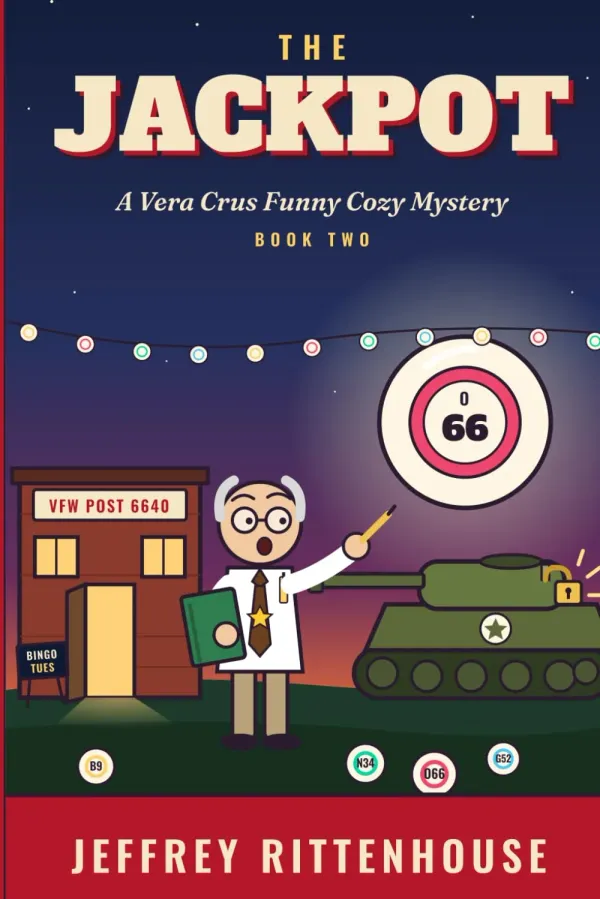
Free to read: the first chapter
The Jackpot
PrologueWednesday, September 30
Freddie Hollenbach had not had a drink in forty four hours, and he could not sleep, so at six in the morning he was walking.
He went down Water Street in his Gulf War cap and the plaid pajama pants he wore to take out the trash, because a doctor on the television had said walking helped, and because his legs wanted something to do. The fog was down. It sat on the town at the height of the second story windows, and the post light in front of Post 6640 made a yellow ball in it, and under the ball, at the corner of the lawn, the old Army tank sat in the wet grass with its gun pointed at the Lutheran church.
Everybody in Vera Crus looked at the tank when they went by, to see if there were kids on it.
There were no kids on it. But the padlock on the hatch was hanging open on its little loop, and the lid of the hatch sat a finger’s width up from the steel, and Freddie stood on the sidewalk and thought, kids. Some kid got in there last night, and he’s going to fall down that hole and break his neck, and it’ll be on the news.
He climbed up. He used the tread and then the fender, the way he had when he was nine years old and Elmer Lutz had chased him off it with a broom. He got his fingers under the edge of the hatch and lifted it.
It was dark inside, and it smelled like an old cellar and cologne.
Ronnie Zettlemoyer was sitting on the floor of the tank with his back against the steel and his legs out in front of him, in his black silk shirt with the red dice on it, like a man who had sat down to rest. His eyes were open. Beside him, under a moving blanket, was the skill game machine he had been trying to sell the post all summer.
Freddie looked at him for as long as he could stand it. He put the lid down, gently, the way you would close a door on somebody sleeping, and climbed down, and sat on the curb in the fog, and took out his phone.
He did not call 911. He called Walter.
Fifty seven days earlier.
Chapter One
Tuesday
On Tuesday evening Walt Brubaker put on his brown tie with the whole gold star on it, crooked down the middle where the two halves met, and went downstairs to go to bingo.
He had packed for it. On the kitchen table sat a green clothbound ledger, three sharpened pencils, a pocket calculator with a paper tape, and a small plastic ruler in case he needed to draw a line.
“It’s bingo, Walter,” said Grace, from the sink.
“I’m aware of that.”
“You don’t need a ruler for bingo.”
“You don’t know that. You’ve never played bingo.”
Grace went to the drawer that wouldn’t close, dug past the twist ties, and came out with a twenty dollar bill. She tucked it into his shirt pocket behind his pens, the way she used to tuck lunch money into Kyle’s jacket.
“For your cards,” she said.
Outside, a horn honked twice, then a third time, longer, which meant Freddie had spilled something.
Freddie’s truck smelled of Old Spice and cough drops and, faintly, of the beer cooler on the passenger floor.
“Rules,” said Freddie, as they turned onto Main Street. “This ain’t golf. These people take it serious.”
“I take everything seriously.”
“Not like this.” Freddie held up one big finger. “Number one. You don’t sit in nobody’s seat. Every seat in that room belongs to somebody, some of them since Nixon. Sit in the wrong one and the room goes quiet.” A second finger. “Number two. You don’t talk during a game. Earl will stop the cage and look at you. You don’t want Earl looking at you.”
“I’ve known Earl for forty years.”
“You gave him back the wrong ladder, Walter. He ain’t forgot.” A third finger. “Number three. When you got a bingo, you yell it. You don’t raise your hand. You yell BINGO like the house is on fire, because if somebody else yells first, they split it with you, and that has ended marriages.”
Walt wrote in the ledger, on the inside cover, in small print: Seats assigned. No talking. Yell.
“And number four,” said Freddie, as they pulled into the gravel lot of Post 6640, at the corner of Main and Water, beside the green tank on the lawn, “if you get a false bingo, it costs you. House rule. False bingo buys the table a pie.”
“What’s a false bingo?”
Freddie looked at him with pity. “You’ll know.”
Inside the door, the guest book lay open on its podium. Walt signed it with the date and his name, and under SPONSORING MEMBER he wrote F. Hollenbach. Then, because he had kept count since 1991 and saw no reason to stop, he wrote a small 213 in the margin and initialed it. The book only came out on meeting nights and event nights, when the bylaws said a guest had to be signed in.
Freddie, watching over his shoulder, thought about thirty five years of tiny numbers in the margins of the guest book, patted Walt on the back, and steered him past the bar.
The bar was on the left, under the glass case where Elmer Lutz’s Commander’s cap sat on a folded flag with his medals, and Shirley Ziegler was behind it. She drew Freddie a Yuengling without looking up and set a ginger ale with a cherry in front of Walt’s stool, the fifth from the end, though he was not going to sit on it tonight.
“Good luck, hon,” she said. “Don’t sit in Elmer’s chair.”
“Which one is Elmer’s chair?”
“You’ll know,” said Shirley.
The bingo room was the old social hall at the back of the post, through a pair of swinging doors with round windows, which stood propped open on busy nights so that the stage looked straight up the room to the bar. It had a water stained drop ceiling and four long rows of folding tables with paper tablecloths, and on every table, in front of every chair, a little kingdom: dabbers standing in rows like lipsticks, troll dolls with orange and purple hair, a ceramic frog, and a small framed photograph of a young woman in a Navy uniform, propped against a sugar packet and facing the stage, so she could see the numbers. One woman had an open tackle box full of dabbers, sorted by color from light to dark. Walt felt a small, unexpected kinship with her.
On a low stage at the front stood a brass cage, a wire drum full of white balls on a crank, and beside it, on a tall stool, sat Earl Fenstermacher. Earl had driven the Vera Crus school bus for thirty one years and was now one of Josh Gehman’s two part time police officers, a long, narrow, gray man who did everything at exactly the speed limit. He found Walt across the room with no expression at all, and looked away.
Freddie went off to the back, because men at the VFW did not play bingo; they watched, holding beers, and made remarks. Walt stood in the aisle with his ledger and tried to find a seat that did not belong to anyone.
“Here,” said a voice. “Before you get yourself killed.”
It came from a small old woman at the end of the third table, in a lavender cardigan and pearls and glasses so thick her eyes floated behind them. In front of her sat a troll doll with a shock of orange hair and a small plaid vest. She pulled out the chair beside her with one foot.
“That’s Elmer’s,” she said. “Elmer passed in February. You can have it till we get used to somebody else in it.”
“Thank you,” said Walt, and sat in Elmer’s chair, and the room did not go quiet, so he supposed it was all right.
“Bea Gackenbach,” said the woman. “You did my taxes in 1987, mine and Herman’s, and you made me claim the cash from the egg money.”
“Did I?”
“You did. I never forgave you. This is Lucky.” She tipped her head at the troll. “Don’t touch him.”
“I won’t.”
“People touch him,” said Bea darkly, “and then they wonder.”
At seven o’clock, the swinging doors opened and Vern Hartzell came through them like a parade.
He was seventy seven and built like the front of a truck, with a white crew cut, a red face and a VFW jacket with the Commander’s patch. On his head sat the Commander’s cap. It was not the soft folded overseas cap the rest of the post wore. It was a stiff navy cap with a short black brim, like a ship’s captain’s, and a thick braid of gold around the band that caught the fluorescent light and made it look like money. No VFW uniform book had ever heard of it. The Commanders of Post 6640 had worn one since 1953, when the first Korea men came home and bought the first of them from a police supply in Allentown, and the District wrote the post up for it every year, and every year the post voted to keep it. He came down the center aisle shaking hands and kissing the tops of heads.
“Evening, Dot. Evening, Marian. Mrs. Gackenbach, you look like a million dollars, which is about what you’ve won off us since 1979. Hello, Lucky.” He patted the troll on the head, and Bea let him. Then he put a hand the size of a skillet on Walt’s shoulder, and his voice filled the room without trying. “Ladies and gentlemen, we have a celebrity with us tonight. Walter Brubaker, the man who did half your taxes.”
The room groaned, and somebody at the back said, “He made me itemize!”
“Now, now,” said Vern. “Walter is a guest of the post, and he did our taxes for twenty years for free, which is more than the government ever did for us.” He lowered his voice. “First night’s on the Commander.” He laid a packet of bingo sheets in front of Walt, put a ten dollar bill in the cash box himself, winked, and moved on before Walt could protest.
He had brought Grace’s twenty for this.
“He does that,” said Bea. “Every new face.” She uncapped her green dabber. “He paid for Elmer’s funeral supper. Out of his own pocket. Pot pie for a hundred and forty people.”
“All right, my darlings,” said Vern, from the stage. “Eyes down. Let’s play some bingo.”
Walt played twelve cards. He had worked out on the drive over that twelve cards gave him twelve times the chance, which was correct. He had not worked out that Earl would call a number every eight seconds.
“Under the B,” said Earl. “Seven.”
Walt found B7 on three cards, dabbed it, and wrote B7 in the ledger.
“Under the O. Sixty two.”
Two cards. Dab. Dab. Write. By the time he looked up, Earl had called N thirty four and G fifty one, and Bea was dabbing with two hands like a woman playing the drums.
Vern had a joke for every number. When Earl called N thirty one, Vern said, “Thirty one, the day my second wife left, and I was so happy I bought a round,” and the room, which had heard it four hundred times, laughed anyway. When Earl called B eleven, Vern said, “Legs eleven, folks. Like my Doris in 1974. She could still outrun me today, and some nights she does,” and the women up front, who all knew Doris, laughed hardest.
Earl did not laugh.
By the fourth game Walt’s twelve cards were starting to swim, and by the sixth the ladies at the next table had stopped pretending not to watch him.
“He’s writing them down,” said one of them, not quietly.
“He’s an accountant, Dot,” said Bea.
“Oh,” said Dot, with deep sympathy, as if Bea had said he had shingles.
In the seventh game, Walt got a line, five dabs straight across the bottom of a card, and his heart jumped. Yell like the house is on fire.
“BINGO,” shouted Walt Brubaker.
The room stopped. Earl stopped the cage. A large calm woman in a VFW Auxiliary vest came down the aisle with a clipboard, took Walt’s card and laid it in front of Earl, and Earl read the numbers back off the board in the bus voice.
“B nine,” said Earl. “Called.” He tapped the light on the board. “I twenty two. Called. N thirty four. Not called.”
“It was called,” said Walt. “I heard it. N thirty four.”
“N thirty four was in game six.” Earl did not look up. “In game seven I called N forty three.”
He had written N43 in the ledger and misread it. The ledger had been right, he had been wrong, and the whole room knew it.
“False bingo,” said the woman with the clipboard, kindly, and handed back his card.
The room made a sound warmer than a laugh, the sound of a hundred and twenty people who had all, at some point, been where he was.
“House rule,” said Vern, beaming. “False bingo buys the table a pie. Walter, my friend, you owe table three a pie.”
Walt turned around in Elmer’s chair. He had never played bingo, but he had walked past this room on Tuesday nights a hundred times on his way to the men’s room, and there had always been a card table by the swinging doors with a white cloth on it, a coffee can for the money, and five or six pies in carriers with masking tape on the handles. APPLE. CHERRY CRUMB. SHOOFLY.
The card table was there, and the white cloth, and the coffee can. There were no pies.
Bea was looking down at Lucky. At the next table, Dot uncapped and recapped her dabber twice.
“Loretta always did the pies,” said Bea, to nobody.
Walt took Grace’s twenty out of his shirt pocket, walked to the card table, and put it in the empty coffee can.
“For next week,” he said. “Somebody can bake something.”
He went back and sat down. Bea, without looking at him, moved Lucky about an inch closer to his cards.
The last game was the jackpot, a blackout, Bea explained in a whisper: every number on the card, all twenty four and the free space, covered in fifty numbers or less. Win it in fifty and you won the progressive jackpot. Miss, and it went on growing, week by week, until somebody did.
Beside the stage stood an old green chalkboard on an easel, and on it, in fat white capitals, someone had written:
PROGRESSIVE JACKPOT $1,100
COVER ALL IN 50 NUMBERS CAPPED PER IRS. OVERAGE TO BUILDING FUND.
Under it, smaller, an old joke nobody had ever erased: AND THE ROOF THANKS YOU.
Earl spun the cage. Fifty numbers took about seven minutes, and nobody came close. At the fiftieth a great sigh went up, and Vern said into the microphone, “And once again, my darlings, the building fund thanks you, and the roof thanks you, and I thank you. Tell your friends we’re not Sacred Heart.”
That got the biggest laugh of the night.
They came out the back door at half past nine into a warm August night full of crickets. Headlights swung across the lawn and caught two small boys sitting on top of the green tank’s turret, eating ice cream sandwiches.
“Hey!” Vern Hartzell came around the corner of the building in his gold braided cap, his keys jingling. “You two. Off. You know better. Somebody broke an ankle on that thing in 1988, and the post paid for it, and the post can’t afford another ankle.” He climbed stiffly up on the tank’s front fender and closed the round hatch on the turret, which had been standing open. He took a ring of keys off his belt, a ring the size of a saucer with thirty keys on it, found one without looking, and snapped a padlock through the hasp.
“Every summer,” he said to Walt, climbing down. “Like raccoons. They figure out how to open it, I put a lock on it, they figure out the lock.” He gave each boy a dollar. “For ice cream. Now git.”
The boys got.
“Good night, Walter.” Vern shook his hand. “You come back next week. They need somebody to laugh at who isn’t me.”
He went off across the lot toward a big silver Lincoln, jingling.
Walt stood by Freddie’s truck while Freddie looked for his keys, which were in his hand. Through the bingo room window he could see the woman in the Auxiliary vest carrying the cash box to the office, where Earl would count it alone, and Earl on the stage, laying the white balls one at a time in their wooden tray. Beside the stage stood the green chalkboard. PROGRESSIVE JACKPOT $1,100. CAPPED PER IRS.
Something about it itched. It was the feeling of a column of figures that was not wrong, exactly, but not quite right either. He had felt it in July, over the fire company’s carnival binder, the summer Dale Kunkle died.
He opened the ledger on the hood of the truck, and on the inside cover, under Seats assigned. No talking. Yell, he wrote in small print: Jackpot. Capped per IRS?
“Walter,” said Freddie, behind him. “Get in. Grace’ll kill me.”