Free to read: the first chapter
The Cabin By The Deep Lake
Chapter 1The Drive North
The drive north took thirteen hours, no matter how fast Dan drove.
It always began the same way—long before sunrise, when the world outside Philadelphia was still asleep and the highways felt borrowed. Dan hit the on-ramp hard, his truck surging forward the moment the lane straightened. He drove fast because that was who he was. The speedometer climbed well past reasonable, and he didn’t bother checking it.
Thirteen hours stood between him and the cabin in St. David, and Dan treated every mile like something to be conquered.
His truck was packed tight: rifle case secured, cooler strapped down, duffel bags wedged behind the seat. Everything had its place. It always did. He shut the radio off before the first song finished. Silence mattered. His grandfather used to say the drive stripped a year off a man, mile by mile. By the time you arrived, only the important things were left.
Behind him—far enough back to be sensible—came the others.
Hugh drove steady and alone. Jeff did the same. Bobby S. followed in his own truck, claiming he liked the quiet even though no one believed him. And then there was the Rob truck—Rob Sr. behind the wheel, Rob Jr. riding shotgun, coffee steaming between them as the dark highway unwound.
“You know he’s already flying,” Rob Jr. said, glancing at the clock.
Rob Sr. smiled faintly. “Let him go. He always gets there first. And we always get there alive.”
They’d learned not to chase Dan. He disappeared early, and somehow—fast or not—the trip still took thirteen hours.
As morning crept in, cities thinned into towns, towns into exits barely worth the sign. Frost edged the fields. Trees loosened leaves already turning red and gold. Somewhere in upstate New York, Dan finally pulled into a rest stop, impatiently tapping the steering wheel while the others caught up.
Bobby S. took one sip of his coffee and grimaced. “You’d think after all these years they’d learn how to make this stuff.”
Dan shrugged. “Gets you moving.”
They didn’t talk about work. Didn’t talk about home. Those conversations belonged south of here.
By the time they crossed into Maine, the air itself felt different—cleaner, sharper, like it scraped something loose in your chest. Cell service flickered and vanished. Roads narrowed. Pavement gave way to gravel, gravel to dirt.
The last hour took the longest.
Even Dan slowed when the forest closed in—thick spruce and pine pressing tight to the road. Ruts and frost cracks forced patience. The trucks moved single file now, tires crunching softly, branches brushing mirrors as if reminding them they were guests.
Then the trees opened.
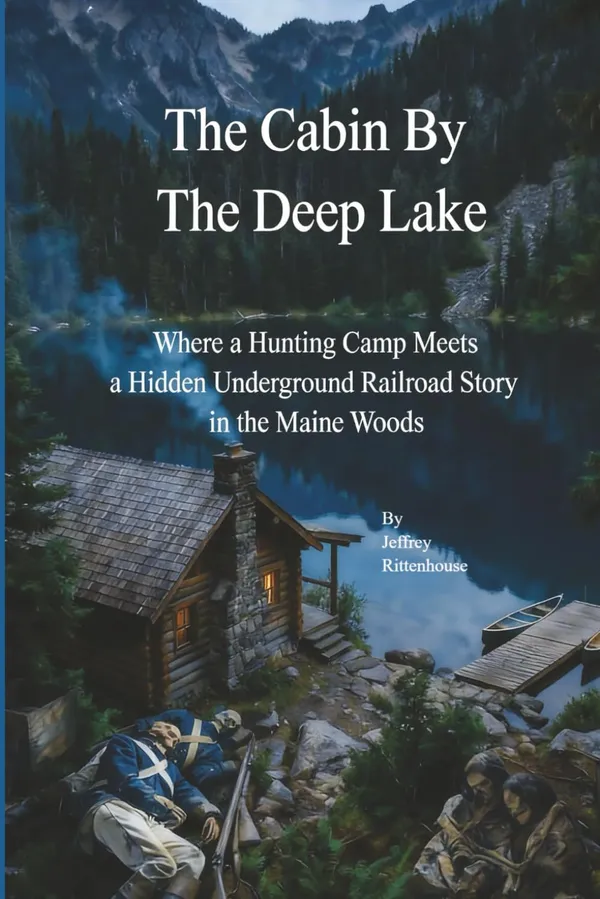
The lake appeared suddenly—deep, dark, and still—ringed by mountains fading into shadow. The cabin sat back from the shoreline like it had grown there, smoke already curling from the chimney.
Dan pulled in first.
He always did.
He shut off the engine and sat for a moment, hands on the wheel. Fast or not, this pause never changed.
The others arrived in staggered order. Doors opened. Boots hit gravel. Hugh and Jeff unloaded without speaking. Bobby S. complained about the cold and immediately started stacking firewood. Rob Sr. stretched and scanned the ridgeline out of habit. Rob Jr. drifted toward the lake, eyes tracing the mountains as if he were trying to memorize them.
The cabin hadn’t changed.
Weathered boards. Solid frame. Inside were real bathrooms, hot and cold running water, and lights that worked when the generator ran. Out back, tucked into a shed, sat the diesel generator—modern comfort, on their terms.
Dan unlocked the door.
The smell was the same as it had always been—wood smoke, iron, old pine boards warmed by fire. The stone fireplace dominated the room, blackened by decades of use. Beside it stood the cast-iron stove, scarred and polished smooth by generations of hands.
They fell into motion without discussion. Wood stacked. Coats hung. Boots lined near the stove. Coffee went on. The fire caught quickly, flames climbing stone dark with history.
Outside, dusk settled over St. David.
The generator roared to life, then smoothed into its steady hum. Lights blinked on. Pipes rattled briefly, then behaved. The world crept just close enough to be useful.
Once the gear was stowed and the fire settled into a steady burn, the mood shifted.
Dan opened the cooler, ice cracking softly as he pulled out beers. Red-and-white cans were passed around—Budweiser for Hugh, for Bobby S., for Rob Sr., and for Rob Jr.
Jeff reached in after them and came up with a green bottle.
“Still drinking that stuff?” Bobby asked.
Jeff smiled. “Someone here has to.”
Jeff was the only one who preferred Heineken, and no one ever argued with him about it. After thirteen hours on the road, nobody had the energy.
Dan set the beers down and reached into a cabinet near the stove. He pulled out a purple velvet bag and loosened the drawstring. The bottle inside caught the firelight as he placed it on the table.
“Figured it fit,” he said.
Bobby grinned. “Close enough to Canada.”
The first pours of Crown Royal went into mismatched glasses—some proper, some not. The whiskey burned warm on the way down, settling into tired muscles and quiet places.
They drank slowly.
The fire cracked. The generator hummed. The lake outside lay dark and still.
Later, someone turned on the television. The signal locked in after a moment, filling the room with noise and color.
“Good,” Bobby said, easing into a chair. “Didn’t drive thirteen hours to miss the Eagles.”
That started it.
They were all from outside Philadelphia, and distance had never weakened their loyalty to the Philadelphia Eagles. Mountains didn’t matter. Wilderness didn’t matter. Sundays still belonged to the National Football League.
Plates filled. Beer cans emptied. The whiskey bottle lowered slowly. The fire burned steady while the generator carried the hum of the modern world just outside the walls.
Rob Jr. watched the game—and the men. The way arguments flared and faded. The way silence fit between them when the noise dipped. He knew he was the youngest by decades. Knew he hadn’t earned the stories yet. But he felt something else too—a sense that this place was willing to teach him, if he paid attention.
When the screen finally went dark, the fire burned low.
One by one, they turned in. Boots drying by the stove. Rifles resting safely in the corner. Tomorrow would be opening day.
Dan stepped outside alone.
Stars crowded the sky, sharp and countless. The lake reflected them faintly. Somewhere in the woods, something moved—wind, maybe. Or something older.
Thirteen hours behind them. A season ahead.
And the land, as always, was waiting.