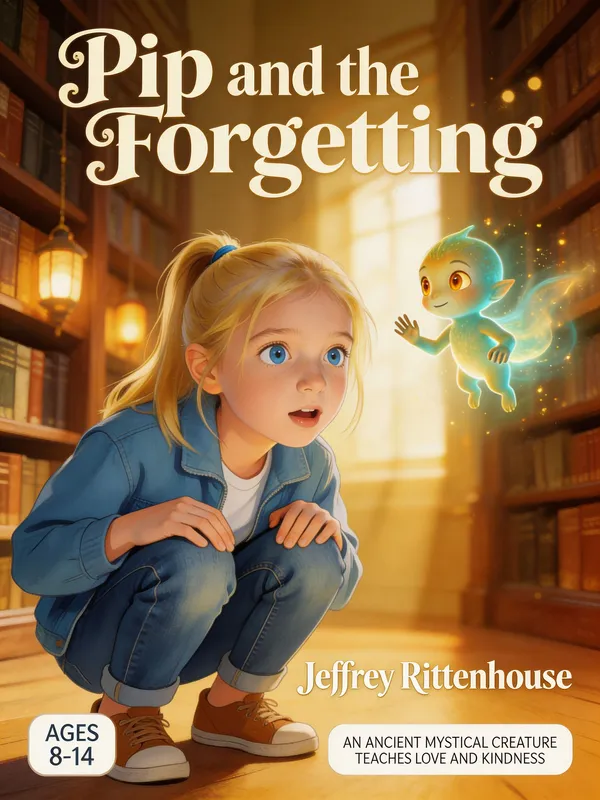
Free to read: the opening
Pip and the Forgetting
Chapter OneThings That Wake Up
The first thing Pip noticed upon waking after a very long sleep was the smell. It was sharp and faintly burnt, with a sweetness underneath that belonged to no flower Pip had ever known. (It was coffee. But Pip didn’t know that yet.)
The second thing was the noise. There had always been noise—wind, rain, the slow conversation of old trees—but this was urgent and everywhere at once, a hundred sounds overlapping into something that felt almost like panic.
Pip pressed both tiny hands against the wall. Behind the old plaster and older wood, the whole world hummed and rushed past without stopping to ask why. Nobody was asking why.
Pips are ancient. They predate libraries. They exist to ask questions, not to answer them. To make sure the universe does not become so thoroughly explained that it stops being wondrous. Wonders evaporate when nobody tends them.
Pip had slept because the wondering had grown very quiet. It had slept in cathedral walls for three centuries, in the roots of an oak for what felt like an afternoon but was eighty years, and once, embarrassingly, inside a grand piano in Vienna for eleven years, woken only by a child banging on the keys. Children were reliable that way.
This library had seemed full of questions. Every book was a question if you read it right. But the people now tapped at glowing rectangles and left without looking up. So Pip had slept.
And now it was time to wake up.
Pip pushed through the plaster the way water pushes through old stone, gently, persistently, and emerged in a small puff of pale dust.
The library was not large. High ceilings, tall windows making rectangles of morning light, shelves reaching places that needed a very tall ladder. The books leaned into each other like tired people on a long bus journey. Pip loved it immediately.
Pip perched on the nearest shelf. A sign on the front door read: LAST DAY OF OPERATION. THANK YOU FOR 94 YEARS. Below it, in smaller letters: SCHEDULED FOR DEMOLITION. FRIDAY.
Pip studied the word demolition. It did not feel like a good word.
Outside, something large and mechanical rumbled past. The windows shivered. A thin pale-blue book slid an inch to the left, as though nervous. Pip patted it gently. “There, there.”
The bell above the door rang. Pip vanished behind a stack of encyclopedias.
The first person through was a woman of about seventy with white hair in a complicated arrangement and a large canvas bag over one shoulder. She walked as though remembering.
The second person was dragged. She was ten, blonde hair escaping a ponytail in every direction, bright blue eyes working very hard at looking bored.
Elle.
Pip noticed her eyes immediately. These were not bored eyes. These were eyes at war with themselves.
“Grandma,” Elle said in the tone of someone filing a formal complaint, “it’s a library. We have books at home.”
“We have books at home,” her grandmother agreed pleasantly, running one hand along a shelf the way you’d greet an old friend. “We do not have these books.”
Pip watched from hiding. She’s pretending, Pip thought. But why?
Then Pip sneezed. A very small, almost inaudible sneeze.
Elle spun around and stared straight at the encyclopedia shelf.
“Hello?” she said, trying to sound unimpressed. “I know something’s there. I heard you.”
Pip stepped out.
For one long moment they simply looked at each other in the morning light.
“You are not a mouse,” Elle said. “No,” said Pip. “What are you?” “A Pip.” “That’s a name. What are you?”
Pip’s enormous eyes sparkled with delight. “Nobody has asked me that in a very long time. What do you think I am?”
Elle stared hard. “I think I am still asleep.” “Are you usually this interesting when you’re asleep?”
Outside, the rumbling grew louder. A man in an orange hard hat peered through the window, frowning at his clipboard.
“Elle,” her grandmother called. “Come look at this, sweetheart, it’s the most wonderful—” “Grandma,” Elle said with quiet authority, “we need to leave. Right now.”
She steered her grandmother out with the practiced efficiency of a very small tugboat. Pip appeared silently on Elle’s shoulder.
“I think the demolition crew might be early,” Elle said.
They were by three days.
On the front steps, Elle’s grandmother began composing an indignant phone message to the city council. Pip and Elle regarded each other.
“You knew,” Elle said. “About the building.” “I suspected demolition was not a good word.” “It means they knock it down.”
Pip looked at the library. Something old and tired crossed its face. “All those questions,” Pip said softly, “just sitting in there.”
Elle looked too. She had not read a single book, yet watching the yellow machine angle its arm, she found—to her considerable irritation—that she cared.
“So,” she said, mostly to distract herself, “you lived in the walls.” “For a while.” “How long is a while?” Pip considered. “What year is it?”
Elle told it. Pip’s eyes widened. “Oh. Quite a long time, then.”