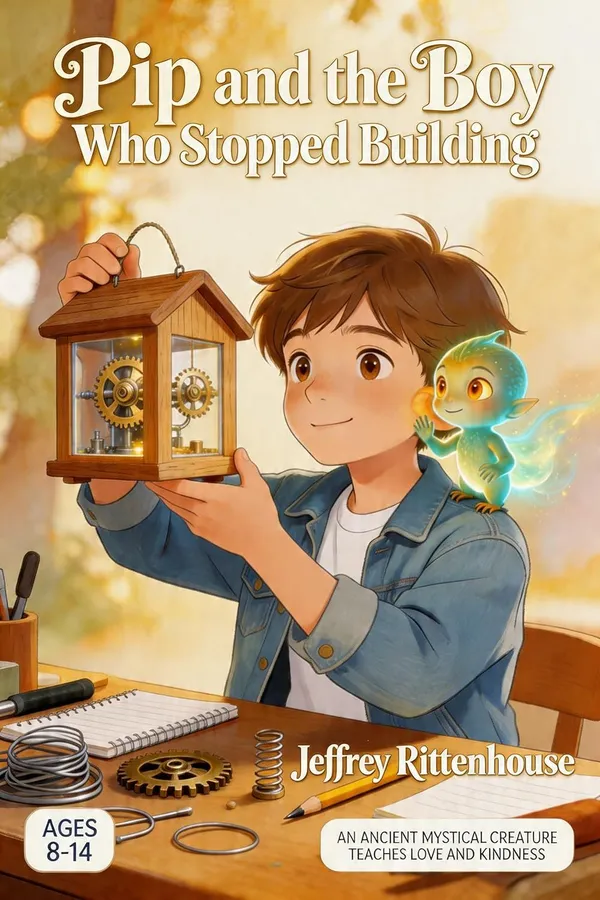
Free to read: the opening
Pip and the Boy Who Stopped Building
Chapter OneWhere Things Still Smell Like Sawdust
The first thing Pip noticed upon waking was the smell.
Not coffee this time—though Pip had come to love coffee deeply and unreasonably in the months since the library. This was something older. Sawdust. Machine oil. The dry, patient smell of wood that had been waiting to become something else. It was the smell of possibility kept in a box, and it was extraordinary.
The second thing was a sound: a bell above a door, old and slightly flat, the kind of bell that had been ringing for so long it had forgotten to be surprised.
Pip pressed both tiny hands against the wall. The plaster here was not old like cathedral plaster or library plaster. It was the plaster of a place that had been useful for a very long time without being grand about it. Pip approved. Usefulness without grandeur was underrated.
Pips are ancient. They predate hardware stores. They exist to ask questions, not to answer them. To make sure the universe does not become so thoroughly explained that it stops being wondrous. Wonders evaporate when nobody tends them.
Pip had slept because the making had grown very quiet. Not everywhere—the world was full of making—but in this particular patch of the world, something had gone still. Pip felt it the way you feel a draft: not as a presence but as an absence. A door left open somewhere that should have been open all along.
Pip pushed through the plaster the way light pushes through old curtains, gently, insistently, and emerged onto a shelf crowded with boxes of nails in fourteen different sizes.
Henderson's Hardware had been here for fifty-two years. Pip could tell by the way the floorboards had worn a groove between the entrance and the register—the shape of a thousand people who knew exactly where they were going. The shelves were dense and organized the way only decades of steady use organize a place. Sandpaper in ascending grades. Hinges sorted by weight. A rack of drill bits that caught the light and threw small sparks of it across the ceiling.
Pip loved it immediately.
A sign on the front door, written in careful block letters: CLOSING AFTER 52 YEARS. THANK YOU, NEIGHBORS. FINAL DAY.
Below it, someone had added in smaller handwriting: We will miss you more than we know how to say.
Pip studied both signs. Then it perched on the edge of the drill-bit rack and waited.
The bell rang. The first person through was a man of about sixty-five with white hair at his temples and the hands of someone who had built things for so long his hands had shaped themselves around the work. He walked slowly, the way people walk in places they are trying to remember.
The second person was pulled.
He was ten, dark-haired, wearing a jacket two sizes too big, and the expression of someone engaged in a quiet, ongoing argument with the concept of being here. His name was Caleb, and his hands were in his pockets.
Pip noticed his hands immediately.
Not the hands themselves—though they were good hands, the kind that knew things without being told. What Pip noticed was where they were. Buried. Out of sight. A person who kept their hands in their pockets all the time was a person who had decided their hands were not needed.
"Five minutes, Grandpa Joe," Caleb said, in the tone of someone filing the world's most patient formal complaint.
"Five minutes," his grandfather agreed, already moving toward the paint aisle with the ease of a man who knew what he was looking for. "Then we'll get lunch."
Caleb stood near the entrance, looking at the floor. He'd gone still in a way that said he'd decided not to be interested.
Pip sneezed. A small, precise, almost imperceptible sneeze.
Caleb's head came up.
He stared at the drill-bit rack with the careful attention of someone who has learned not to show they're looking.
"Hello?" he said, quietly enough that his grandfather couldn't hear.
Pip stepped out.
For one long moment they looked at each other in the light of fifty-two years of a hardware store's worth of afternoon.
"You're not a squirrel," Caleb said.
"No," said Pip.
"What are you?"
Pip's enormous eyes lit up. There it was—a question asked properly. "Nobody has asked me that in a while. What do you think I am?"
Caleb looked Pip over, deciding whether he should be embarrassed about noticing. The warm gold-teal glow. The ancient, patient eyes. The way Pip sat on the shelf as though it had always been there and had simply been waiting for someone to look.
"I think," Caleb said slowly, "that I am going to pretend I didn't see you."
"Does that usually work?" Pip asked, with genuine interest.
"No," Caleb admitted.
From the paint aisle, his grandfather called: "Caleb! Come look at this—they've got the old oil-based stain. The kind I used on your grandmother's porch."
Caleb glanced toward the voice, then back.
Pip climbed down from the shelf and crossed the floor to him.
"I'll be very small," Pip said, and stepped into the large front pocket of Caleb's jacket before he could object.
"That's—" Caleb started.
"Shhh," Pip said pleasantly. "Your grandfather is calling."
Grandpa Joe held up a can of stain the way someone holds up something they'd thought they'd never see again. "Do you know how long I've been looking for this?" He turned it over, reading the label with quiet satisfaction. "The new water-based stuff never goes on the same way. Your grandmother always said she could tell the difference."
From the pocket, Pip peered out.
Grandpa Joe looked down at the pocket. His eyes went very still for a moment—not afraid, not confused, just the kind of still that comes from having lived long enough to recognize something outside the usual categories.
"Hello," Pip said.
"Well," Grandpa Joe said. And that was all. He turned back to the shelf of stains, like a man who'd decided some things didn't need explaining.
At the register, Mr. Henderson was wrapping things in paper bags with the careful attention of someone who has done this ten thousand times and has not stopped meaning it. He was seventy-three, with a mustache and the kind of smile that had been earned through long use.
"Joe," he said. "Last time."